No Products in the Cart
History of Rubber
Written by Mohammed Aftab

Last Updated November 4, 2026
You've used rubber today, probably without thinking about it. It's in the tires on your car, the soles of your shoes, rubber bands, balloons, erasers, the grip on your pen, and the latex mattress or topper you sleep on.
Rubber's story runs from ancient Mesoamerican ball courts to the factories of the industrial age, and it includes some hard chapters too. This guide covers what natural rubber is, who first used it, how vulcanization changed everything, how rubber spread around the world, why it was so valuable, and how it became the latex foam in today's bedding.
Quick answer
People in Mesoamerica were making rubber balls from tree latex by about 1600 BC. Charles Goodyear's vulcanization process (discovered in 1839, patented in 1844) made rubber stable in heat and cold. In 1876, rubber tree seeds taken from Brazil were grown at Kew Gardens in London and sent to Asia, where most natural rubber is grown today. John Boyd Dunlop's pneumatic tire (1888) and the car drove huge demand, and synthetic rubber, scaled up during World War II, now makes up a little over half of the rubber used worldwide.
Key Takeaways:
- Natural rubber is made from latex, the milky fluid tapped from the bark of the rubber tree, Hevea brasiliensis, which is native to the Amazon basin.
- Among the oldest known rubber objects are balls from Mexico's Gulf Coast dated to about 1600 BC, made for the Mesoamerican ballgame.
- Vulcanization, heating rubber with sulfur, fixed raw rubber's habit of turning sticky in summer and brittle in winter. Goodyear received U.S. patent 3,633 for it on June 15, 1844.
- The Amazon rubber boom (about 1879 to 1912) and the Congo Free State relied on forced labor, a part of rubber's history worth knowing.
- Plantations in Asia, grown from seeds sent via Kew in 1876, replaced wild rubber, and synthetic rubber grew rapidly during World War II.
- Latex foam for bedding is made by the Dunlop or the Talalay process. Turmerry's organic Dunlop latex is GOLS certified (CU 886641).

What Is Natural Rubber?
Natural rubber comes from nature, as the name suggests. It's made from latex, a white, milky fluid held in tiny vessels just under the bark of the rubber tree. Latex is mostly water, with suspended rubber particles made of a natural polymer called polyisoprene. Those long, coiled molecules are what make rubber stretch and snap back.
Nearly all commercial natural rubber comes from one species, Hevea brasiliensis, also called the Pará rubber tree. It's native to the Amazon basin, but today it's grown mostly on plantations and small farms in Southeast Asia, with more in South Asia and West Africa.
Before plantations took over, rubber was also gathered from wild sources, including the Castilla tree of Central America, African rubber vines, and the Asian rubber fig (Ficus elastica, often called the "India rubber plant"). By the early 20th century, plantation-grown Hevea had largely replaced them.
How latex is collected
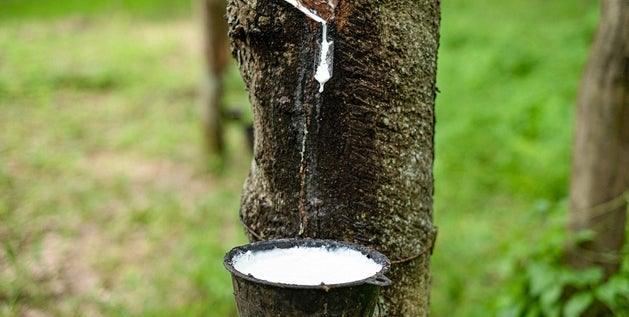
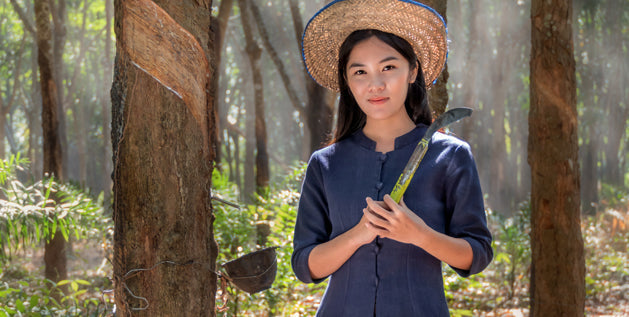
Latex is harvested by tapping. A trained tapper uses a special knife to shave a thin strip of bark, often just a millimeter or two, along a cut that slopes downward part of the way around the trunk. The cut opens the latex vessels without reaching the cambium, the tree's growth layer, so the bark can grow back.
Latex then trickles along the cut and into a cup. It keeps flowing for a few hours until it seals the cut naturally. Tapping usually starts very early in the morning, and trees are commonly tapped every two to three days. Because the tree isn't cut down, a well-tapped tree keeps producing for about 25 to 30 years. Our guide to the lifecycle of a natural rubber tree covers each stage.
Good to know
Left alone, latex thickens and clumps (coagulates) in the cup. When it needs to stay liquid, for example for latex foam, it's stabilized, usually with ammonia, and later concentrated.
From there, rubber is processed in different ways. Solid rubber is shaped by calendering (pressing into sheets) and extrusion (pushing through a shaped opening), then cured by vulcanization. Liquid latex is used for dipped goods like gloves and balloons, and for foam in latex mattresses, latex toppers and latex pillows.
Rubber History Timeline at a Glance
Here are the milestones covered in this guide, in order:
| When | What happened |
|---|---|
| About 1600 BC | Rubber balls are made on Mexico's Gulf Coast, among the oldest known rubber objects |
| 1730s–1740s | French scientist Charles Marie de La Condamine sends rubber samples from South America to Paris |
| 1770 | English chemist Joseph Priestley notes that it rubs out pencil marks, giving "rubber" its English name |
| 1823 | Scottish chemist Charles Macintosh patents a waterproof fabric made with rubber |
| 1839 | Charles Goodyear discovers that heating rubber with sulfur cures it |
| 1844 | Goodyear receives U.S. patent 3,633 for vulcanized rubber |
| 1876 | Rubber tree seeds from Brazil are grown at Kew Gardens and sent on to Asia |
| About 1879–1912 | The Amazon rubber boom |
| 1885–1908 | The Congo Free State, where wild rubber was collected by forced labor |
| 1888 | John Boyd Dunlop develops a practical pneumatic tire |
| Late 1920s | Latex foam is developed, the start of the Dunlop process |
| 1930s | New synthetic rubbers appear, including Germany's Buna rubbers and neoprene in the U.S. |
| 1941–1945 | The U.S. builds a synthetic rubber industry during World War II |
| Today | Synthetic rubber is a little over half of world use; most natural rubber comes from Southeast Asia |
When Was Rubber Discovered, and by Whom?
No one person discovered rubber. It was first used by Indigenous peoples of Mesoamerica, in what is now Mexico and Central America. Among the oldest known rubber objects are balls found at El Manatí, a site on Mexico's Gulf Coast, dated to about 1600 BC. That region is linked with the early Olmec, whose name is often translated from the Aztec language, Nahuatl, as "rubber people."
These balls were made for the Mesoamerican ballgame, played across the region for thousands of years. The exact rules aren't fully known, but players are believed to have struck the heavy, solid ball mainly with their hips rather than their hands. Balls varied in size, and the largest are estimated to have weighed several pounds.
The ballgame was more than a sport. It held religious meaning, and at some times and places it was linked to ritual sacrifice. It was also played for recreation and community events.
Early rubber science
Researchers have found that Mesoamerican rubber makers mixed latex with the juice of a local morning glory vine. Changing the mix changed the result, from bouncy balls to tougher rubber, centuries before modern rubber chemistry.
Later cultures, including the Maya and the Aztecs, used rubber for balls, containers and waterproofing. They coated cloth with latex to keep out water, and the Maya are said to have made shoes by dipping their feet in latex and letting it set.
Europeans learned about rubber after the Spanish arrived in the Americas. In the 1730s and 1740s, French scientist Charles Marie de La Condamine sent samples from South America to Paris and described the material, and he is often credited with introducing it to European science. The French word caoutchouc comes from an Indigenous South American word, and in 1770 Joseph Priestley's eraser discovery gave English its word "rubber."
What Led to the Invention of Modern Rubber?
By the early 1800s, rubber was being made into waterproof coats, shoes and fabrics. In 1823, Charles Macintosh patented a waterproof fabric made by sandwiching rubber between layers of cloth, and a rubber craze followed. But raw rubber had a serious flaw: it turned soft and sticky in summer heat and stiff and brittle in winter cold. Many early rubber businesses failed as customers lost faith in it.
An American inventor, Charles Goodyear, set out to fix that. From the mid-1830s he experimented for years, through the Panic of 1837, business failure, debt and time in debtors' prison. He is said to have sold his furniture and moved his family into cheap lodgings so he could keep working.
In 1839 he found the answer. The story most often told is that he accidentally dropped a mix of rubber and sulfur onto a hot stove. Instead of melting, it turned firm and flexible. Heating rubber with sulfur cured it, so it no longer melted in heat or cracked in cold.
1839Goodyear discovers sulfur curing
June 15, 1844U.S. patent 3,633 for vulcanized rubber
VulcanRoman god of fire the process is named after
1860Goodyear dies, still in debt, at 59
Goodyear spent the next few years refining the process and received U.S. patent 3,633 on June 15, 1844. The process was named vulcanization, after Vulcan, the Roman god of fire. In Britain, Thomas Hancock patented a similar sulfur-curing process at around the same time.
Vulcanization turned rubber from a seasonal curiosity into a dependable industrial material. It's still the basis of almost every rubber product today, including the latex foam in mattresses and pillows, which is cured (vulcanized) in an oven.
Goodyear himself gained little from it. He spent years in costly patent disputes, struggled with debt, and died on July 1, 1860, at age 59. The Goodyear Tire & Rubber Company, founded decades later in 1898, was named in his honor; he had no connection to it.
How Did Rubber Gain Global Attention?
Once vulcanization made rubber reliable, demand grew quickly. Three periods shaped rubber into the global material it is today: the rubber boom before World War I, the two world wars, and the decades after World War II.
1. Before World War I: the rubber boom
Bicycles and then cars needed tires. John Boyd Dunlop, a Scottish-born veterinarian working in Belfast, is often credited with the first practical pneumatic (air-filled) tire in 1888, although Robert William Thomson had patented an air-filled tire decades earlier. When Henry Ford began mass-producing cars in the early 1900s, the demand for rubber soared.
At first, most of that rubber came from wild trees and vines. In the Amazon, the rubber boom, usually dated from about 1879 to 1912, made cities such as Manaus in Brazil rich. But much of the rubber was gathered by Indigenous people and migrant workers under systems of debt bondage and forced labor.
The best-documented case is the Putumayo River region on the border of Peru and Colombia, where Julio César Arana's Peruvian Amazon Company operated with London backing. In 1909, accounts by American engineer Walter Hardenburg drew public attention to abuse there. The British government sent consul Roger Casement to investigate in 1910, and his report confirmed widespread violence against Indigenous workers. Arana was never convicted and later served as a senator in Peru. Many Indigenous communities in the region suffered severe population losses.
In Central Africa, the Congo Free State (1885 to 1908), run as the personal colony of King Leopold II of Belgium, used forced labor to collect wild rubber, enforced through violence. International reporting, including Casement's 1904 report, led Belgium to take over the territory in 1908.

The wild-rubber trade was eventually overtaken by plantations. In 1876, Henry Wickham shipped about 70,000 Hevea seeds from Brazil to the Royal Botanic Gardens at Kew, near London. The shipment is often described as smuggling, though historians still debate that label. Only a small share germinated, and the seedlings were sent to Ceylon (now Sri Lanka), Singapore and other British colonies in Asia.
In Singapore, Henry Nicholas Ridley, director of the Singapore Botanic Gardens, promoted rubber so tirelessly that he was nicknamed "Mad Ridley." He is credited with developing a tapping method that harvests latex without killing the tree, and with persuading planters in Malaya to grow rubber. By the early 1910s, Asian plantations were producing more rubber, more cheaply, than the wild trade could, and the Amazon boom collapsed.
2. World War I and World War II
In both world wars, rubber was a strategic material. Armies needed it for truck and aircraft tires, gas masks, hoses, seals and insulation. During World War I, Germany was cut off from natural rubber by the Allied blockade and made a limited amount of an early synthetic called methyl rubber.
Synthetic rubber research continued between the wars. In the 1930s, German chemists developed the Buna rubbers, and in the U.S. chemists at DuPont developed neoprene.
World War II brought the biggest shock. When Japan occupied Southeast Asia in 1941 and 1942, the U.S. lost access to most of its natural rubber supply. The U.S. government teamed up with rubber companies, the petrochemical industry and university labs to build a synthetic rubber industry almost from scratch. According to the American Chemical Society, U.S. output of general-purpose synthetic rubber grew from 231 tons in all of 1941 to about 70,000 tons a month by 1945.
3. After World War II
The wartime synthetic rubber industry didn't disappear. Synthetic rubbers such as styrene-butadiene rubber (SBR) became cheap, consistent and widely used, especially in tires. Today, synthetic rubber makes up a little over half of the rubber used worldwide, and natural rubber the rest.
Natural rubber is still essential, though. Its strength and elasticity make it the preferred choice for jobs such as heavy-duty tires, and it's the raw material for natural latex foam. Most of it still comes from the plantation belt that grew out of those Kew seedlings: Thailand is the largest producer, followed by Indonesia, with Vietnam, India, China, Malaysia, Sri Lanka and West African countries also important. A fungal disease called South American leaf blight has long made large plantations difficult in the tree's Amazon homeland.
Curious how the two compare in bedding? Read synthetic latex vs. natural latex.
Why Was Rubber Such a Valuable Commodity?
Why rubber, and not something else? The answer is in its properties. Processed rubber combines qualities that few other materials offer together, which is why traders, manufacturers and governments competed so hard for it.
Resilience
Rubber bounces back after being squeezed or stretched and quickly regains its shape. That makes it ideal for seals between moving and stationary parts.
Elasticity
Rubber is an elastomer. Its long, flexible molecules let it stretch to several times its original length and return to shape when released.
Tensile strength
Tensile strength is the force needed to pull a material apart, measured in psi or megapascals. Natural rubber's is high, which is why designers rely on it for parts that stretch.
Tear resistance
Rubber holds out against tearing, even around rough edges and sharp objects.
Abrasion resistance
It stands up to wear from friction, which is why rubber is used for tire treads, shoe soles and conveyor belts.
Waterproofing
Rubber keeps water out. Mesoamerican peoples coated cloth with latex, and liquid rubber is still used to waterproof many products.
Temperature range
A commonly quoted working range for natural rubber is about -67°F to 180°F (-55°C to 82°C). Some synthetic rubbers, such as certain silicone grades, are engineered to handle much more heat.
Hardness on demand
Vulcanization lets makers set how firm rubber is, from soft and stretchy to very hard, depending on how much sulfur is used and how it's cured.
Fun fact
In engineering terms, steel is "more elastic" than rubber. Elasticity there means how strongly a material resists being deformed and returns to its exact shape, and steel scores far higher. Rubber's special talent is how far it can stretch and still spring back.
Put those properties together, and it's easy to see why rubber became one of the most sought-after materials of the industrial age.
From Rubber to Latex Foam: Dunlop and Talalay
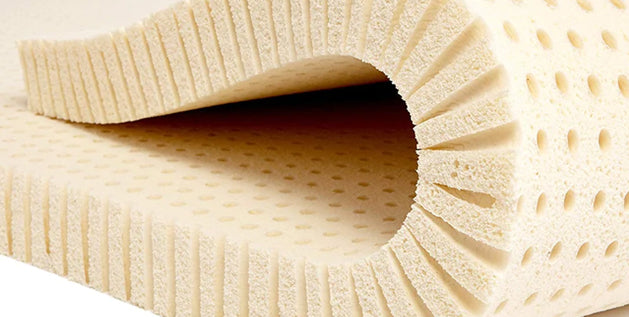
Rubber reached the bedroom in the late 1920s, when latex foam was developed. Instead of drying latex into solid rubber, makers whipped liquid latex into a froth and cured it, creating a springy, breathable foam for mattresses, cushions and pillows. Today, latex foam is made by one of two processes:
Dunlop latex
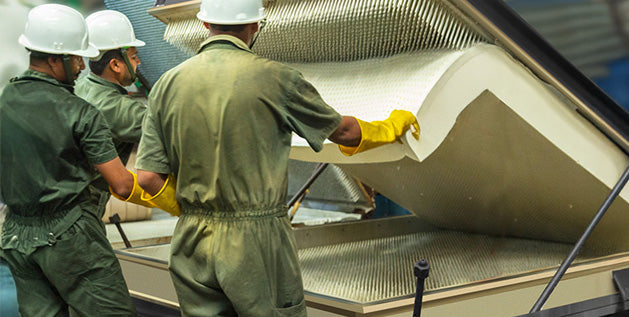
Named after the Dunlop rubber company, where latex foam was first developed. The latex is whipped, poured into a mold and baked (vulcanized). It's typically denser, with a solid, supportive and springy feel.
Talalay latex
Named for the Talalay family, who developed the process. The mold is partly filled, then the latex is vacuum-expanded, flash-frozen and baked. It's typically lighter and very even, with an airy, bouncy feel.
Both are real natural latex, and which one you'll like is mostly a matter of feel. Our Dunlop vs. Talalay latex guide compares them in detail, and how latex mattresses are made follows the factory steps.
Turmerry's latex
The organic Dunlop latex in Turmerry's all-latex mattresses and latex toppers is GOLS certified (Global Organic Latex Standard, Control Union CU 886641). The Organic Latex Hybrid Mattress is different: it uses FSC-certified Talalay latex, which is not GOLS certified, with a GOTS-certified organic cotton cover. Learn what GOLS covers in our GOLS certification guide.
Turmerry's all-latex mattresses are built from separate latex layers inside a zippered organic cotton cover, so you can unzip the cover and see the latex for yourself. Browse latex mattresses or latex mattress toppers.
Why Rubber's History Still Matters
Rubber is so ordinary now that it's easy to take for granted. Yet it shaped transport, industry, medicine and war, and its spread around the world came at a real human cost in the Amazon and the Congo.
That history is one reason it's worth knowing where your rubber comes from. Today, plantation tapping lets a rubber tree give latex for decades without being cut down, and independent standards help buyers see how materials are produced: GOLS for organic latex, and the Forest Stewardship Council (FSC) for responsibly managed forests and plantations. To learn more about the material itself, read all about latex material.
Frequently Asked Questions

SHOPPING FOR A NEW MATTRESS?
Choose 7, 10 or 12 inches and swap layers to change the feel. 365-night trial, free pillows with every mattress.
$719.20 $899.00From. Code BF20 is added at checkout.
Get exclusive offers by email
Sale alerts and new sleep guides. Unsubscribe anytime.
Shop what's in this guide
 7 Zone Organic Latex Mattress$719.20
 7 Zone Latex Mattress Topper$84.15
 Organic Waterproof Mattress Protector$50.15
 Organic Latex Pillow$83.30
Starting prices. Sale codes BF20 and BF15 are added at checkout.

Disclaimer: What is said in this article has been referenced from multiple sources and is intended only for educational and informational purposes. Please note that no content in this article is a substitute for professional advice from a qualified doctor or healthcare provider. Always consult an experienced doctor with any concerns you may have regarding a health condition or treatment, and never disregard any medical suggestions or delay in seeking treatment because of something you read here.
