No Products in the Cart
Mattress Thickness Guide
Written by Mohammed Aftab

Last Updated November 21, 2026
Mattress thickness, also called mattress height, depth or profile, changes more than how tall your bed looks. It affects how much cushioning you feel, how well the mattress holds up under your weight, how easy the bed is to get into, and which sheets will fit. This guide explains why thickness matters, the five common thickness ranges, what the comfort and support layers inside a mattress do, and how to pick the right thickness for your body, sleep position, bed frame and bedroom.
Quick answer
Most mattresses are 8 to 12 inches thick, and 10 to 12 inches suits most adults. If you weigh under about 130 lbs, 8 to 10 inches is often enough. If you weigh over about 230 lbs, look for 12 inches or more, or at least 10 inches with firm support layers. Thinner 5 to 8 inch mattresses suit kids, bunk beds, RVs and guest beds. Before you buy, add any topper to the mattress height and check that your fitted sheets have a deep enough pocket.
Key Takeaways:
- Common mattress thickness ranges are low profile (2-5 inches), slim (5-8 inches), standard (8-12 inches), thick (12-16 inches) and extra thick (over 16 inches).
- Every mattress has a support layer (the base) and a comfort layer on top. Thickness alone doesn't make a bed soft or firm; the materials and firmness of those layers do.
- Choose thickness based on your body weight, sleep position, sleep partners, bed base, bed height, bedroom and how often you move the mattress.
- Thicker mattresses usually give more cushioning and room for more layers, but they cost more, weigh more, raise the bed and need deeper fitted sheets.
- Thinner mattresses are lighter, lower and often more affordable, and they work well for kids, bunk beds and RVs, but heavier sleepers and side sleepers may want more depth.
- Turmerry's latex mattresses come in 7, 10 and 12 inch builds (plus an 11 inch Latex Hybrid), and the zip cover lets you change the layers inside.

Most mattresses sold today fall between 8 and 12 inches thick, but the right thickness differs from person to person. A heavier sleeper may press through a thin mattress and feel the base underneath, while a lighter sleeper may find a thin mattress perfectly comfortable. The sections below help you work out where you fit.
Why Does Mattress Thickness Matter?
The thickness of a mattress affects how it feels, how it performs and how it fits into your bedroom. Here are the eight things it changes.
Comfort
A thicker mattress has room for more material, so it can add more cushioning and a plusher feel. A deeper comfort layer also has more room to contour around your shoulders and hips for pressure relief.
Support
Thicker mattresses usually have a deeper support core, so they can carry more body weight before you sink through to the base. That matters most for heavier sleepers and couples.
Durability
More material, especially a thicker support core, generally means the mattress handles weight better over the years and is less likely to sag early. Materials matter just as much: dense latex holds up differently from low-density foam.
Bed height
The thicker the mattress, the taller your bed. That affects how easy it is to sit down and get up, and how the bed looks in the room. See our guide to bed height.
Weight distribution
Thicker mattresses tend to spread body weight over a larger area, so fewer spots press hard into the bed. Many couples also find a deeper mattress passes less motion from one side to the other.
Sleeping position
Side sleepers often like more depth for cushioning at the shoulders and hips. Back and stomach sleepers can be comfortable on a thinner, firmer mattress that keeps the hips from sinking.
Sheets and bedding
A taller mattress needs fitted sheets with a deeper pocket, and a mattress protector that fits its depth. Add a topper and you need even more.
Cost and weight
More material means a higher mattress price and a heavier mattress to move, rotate or carry upstairs.
Tip
Want a taller bed without a thicker mattress? Raise the base instead with bed risers, a taller frame or an adjustable bed frame set to your preferred height.
What Are the Different Mattress Thicknesses Available Today?

Mattress thickness profiles fall into five broad types. Here's how they compare at a glance:
| Profile | Thickness | Best for | Keep in mind |
|---|---|---|---|
| Low profile | 2-5 inches | Trundle beds, floor beds, daybeds, very low ceilings | Little cushioning; usually not an everyday bed for adults |
| Slim | 5-8 inches | Kids, bunk beds, RVs, guest rooms, lighter adults | Heavier and side sleepers may want more depth |
| Standard | 8-12 inches | Most adults, couples and sleep positions | The widest choice of mattresses, sheets and frames |
| Thick | 12-16 inches | Heavier sleepers, couples, people who like extra cushioning | Taller bed, heavier mattress, needs deep-pocket sheets |
| Extra thick | Over 16 inches | Sleepers who want a very tall bed or many comfort layers | Costs the most; harder to move and to get in and out of |
Low Profile Mattresses (2-5 inches)
A low-profile mattress, as the name suggests, sits close to the ground. At 2 to 5 inches thick, its slim build suits trundle beds, daybeds, floor beds and rooms with low ceilings. It won't have the plushness of a thicker mattress, so it works best as an occasional or space-saving bed rather than an adult's everyday mattress.
Slim Mattresses (5-8 inches)
A slim mattress is 5 to 8 inches thick. It's a good fit for children and growing teens, bunk beds, RVs and guest rooms, and for lighter adults who like a firmer feel. A slim mattress gives more cushioning than a low-profile one, though heavier sleepers usually want more depth.
Good to know
Bunk beds and loft beds list a maximum mattress thickness for a reason: the guardrails need to rise well above the top of the mattress (US safety rules call for at least 5 inches). That's why a 7-inch mattress, like Turmerry's Organic Kids Mattress, is a popular bunk bed choice. Always check your bed's label first.
Standard Mattresses (8-12 inches)
The standard thickness of 8 to 12 inches is the most versatile, and it's the right range for most adult sleepers. It has room for a solid support core and a comfortable top layer, so it suits back, side, stomach and combination sleepers across a wide range of body weights. It's also the thickness most sheets, protectors and frames are made for.
Thick Mattresses (12-16 inches)
A thick mattress, sometimes called a deep mattress, is 12 to 16 inches thick. It usually has several layers of latex, foam or coils, with plush comfort layers over a thick support core, which makes it a good choice if you want extra cushioning or weigh more than about 230 lbs.
Extra Thick Mattresses (Above 16 inches)
Anything over 16 inches is extra thick. Also called extra deep or extra tall mattresses, they typically stack several comfort layers over a coil or foam core. They aren't for everyone: they cost more, weigh more and make the bed noticeably taller, and many sleepers, including heavier ones, are just as comfortable on a well-built 12 to 14 inch mattress.
Turmerry Mattress Thickness Options
Here are the thicknesses you can choose across Turmerry mattresses. Heights include the organic cotton cover and are approximate. You can also shop by height: 7 inch mattresses, 10 inch mattresses and 12 inch mattresses.
| Mattress | Thickness | What's inside | Good fit for |
|---|---|---|---|
| 7 Zone Organic Latex Mattress | 7, 10 or 12 inches | 7": two 3" latex layers, flippable (Medium/Firm or Firm/Extra Firm). 10": three 3" layers, Soft to Extra Firm. 12": four 3" layers | Most sleepers; pick 10" or 12" for more cushioning |
| Dual Side Latex Flippable | 7 inches | Two 3" latex layers with a different firmness on each side | Back and stomach sleepers, guest rooms, anyone who wants two feels in one |
| Organic Egg Crate Mattress | 10 or 12 inches | Two or three 3" latex layers under a 2.4" egg crate latex top | Sleepers who like a softer, contoured surface |
| Bigg+ Natural Latex Mattress | 12 inches | Four 3" latex layers: three Extra Firm, plus a Medium Firm, Firm or Extra Firm top | Sleepers over about 230 lbs |
| DIY Hybrid Mattress With Latex | 10 or 12 inches | Pocket coils with one (10") or two (12") latex comfort layers | Sleepers who want coil bounce with a latex feel they can adjust |
| Organic Latex Hybrid Mattress | 11 inches | 2" FSC-certified Talalay latex over 8" pocket coils, medium | Couples and combination sleepers who like a hybrid |
| RV Mattress | 7 or 10 inches | Latex layers in RV, short and bunk sizes, Medium or Firm | 7" for lighter and average-weight sleepers; 10" for heavier sleepers |
| Organic Kids Mattress | 7 inches | Latex in Soft, Medium or Firm, in Twin, Twin XL and Full | Kids, teens and bunk beds |
The 7 Zone mattress page shows each height as a to-scale layer stack, firmness by firmness, in its dimensions tab. Our all-latex mattresses use GOLS-certified organic Dunlop latex; the Organic Latex Hybrid is the exception, with FSC-certified Talalay latex and a GOTS-certified organic cotton cover.
Tip
Most of our latex mattresses are separate layers inside a zippered organic cotton cover. If the feel isn't quite right after a few weeks, you can unzip it, see the layers and rearrange them, or ask for a free layer swap, all within the 365-night trial.
What Defines a Mattress's Thickness?

A mattress's thickness is the sum of its layers: a support layer at the bottom, one or more comfort layers on top, and the cover. How thick each one is, and what it's made of, shapes how the mattress feels.
Support layer (base)
The base forms the supportive core of a mattress. It's usually firm latex, high-density foam or pocketed coils, and it gives you a steady foundation so you don't sink too far. As a rule of thumb, look for a support core that makes up at least half of the mattress's total thickness.
Comfort layer
The comfort layer sits on top of the base. It's often softer latex (Dunlop or Talalay), wool, cotton or foam, and it contours to your body for pressure relief. A thicker comfort layer gives more cushioning; a thinner one gives a firmer feel.
For example, the 10-inch 7 Zone mattress in Medium has a 3" Firm latex base, a 3" Firm middle layer, a 3" Medium top layer and a 1" organic cotton cover. The 12-inch version adds a 3" Extra Firm layer at the bottom, for deeper support. Because each layer is separate, you can see exactly what makes up the 10 or 12 inches.
How Thick Should a Mattress Be?
Most mattresses are around 8 to 12 inches thick, and that's how thick a mattress should be for most adults. There are three good reasons this range is so popular.

Balance
An 8 to 12 inch mattress has room for a cushioning comfort layer and a support core thick enough to hold you up, at a reasonable price.
Easy to dress
Standard sheets, blankets, frames and mattress protectors are made for this range, so bedding is easy to find.
Easy to live with
It's lighter than a thick mattress, so moving or rotating it is more manageable, and the bed is a comfortable height on most frames.
Use this chart as a starting point. It combines body weight and sleep position, the two biggest factors.
| Body weight | Side sleepers | Back sleepers | Stomach sleepers |
|---|---|---|---|
| Under about 130 lbs | 8-10 inches, with a softer comfort layer | 8-10 inches | 7-10 inches, Medium or Firm |
| About 130-230 lbs | 10-12 inches | 10-12 inches | 8-10 inches, Medium or Firm |
| Over about 230 lbs | 12-14 inches | 12 inches, or 10 inches with firm support layers | 10-12 inches, Firm or Extra Firm |
Sharing the bed? Aim for about 10 to 14 inches and choose for the heavier partner, or pick a split mattress so each side can have its own firmness.
Good to know
Lighter sleepers don't sink far into a mattress, so a very thick, firm mattress can feel harder than expected. A moderate thickness with a softer top layer usually feels better than simply going thicker.
Thick Mattresses vs. Thin Mattresses: Which Is Better?
While the standard 8 to 12 inch range suits many people, the decision is yours. Here are the pros and cons of each, so you can decide how thick your mattress should be.
Thicker mattresses
Pros
- More cushioning, contouring and pressure relief, with a deeper support core.
- Handle more weight, so they suit heavier sleepers and couples who share a bed.
- Many absorb motion well, so partners disturb each other less.
- More material to withstand wear, so a well-made thick mattress can last a long time.
Cons
- Lightweight sleepers under about 130 lbs may find a thick, firm mattress firmer than they like.
- More material means a higher price.
- Thick memory foam can hold body heat; breathable materials such as latex, wool and coils help.
- Heavier, so harder to move and rotate.
- A taller bed can be harder to get into for shorter people or anyone with limited mobility.
Thinner mattresses
Pros
- Usually feel firmer, which many back and stomach sleepers like.
- Fit bunk beds, daybeds, RVs and rooms with low ceilings.
- Lighter and easier to move, rotate or flip.
- Use less material, so they often cost less.
Cons
- A thinner comfort layer and less material overall can wear sooner.
- Less cushioning and pressure relief for side sleepers and heavier sleepers.
- Less depth to carry the weight of couples or families who share the bed.
- On a low frame, a very thin mattress can make the bed too low to get up from easily.
How Can You Find the Best Mattress Thickness for You?

Only you can decide which thickness feels best, but these seven questions will get you close.
-
Comfort needs and mobility
If you want more pressure relief at the shoulders and hips, a thicker mattress with a deeper comfort layer gives you more cushioning. A pressure-relieving topper can add some on a mattress you already own. If getting in and out of bed is hard, a moderate thickness on the right frame keeps the bed at a comfortable height. If you have a health condition, ask your doctor what kind of sleep surface suits you. If you sleep hot, materials matter more than thickness; see our tips on how to sleep cool at night.
-
Sleeping position
Side sleepers need cushioning at the shoulders and hips without losing support, so they tend to do best on thicker mattresses, around 10 to 14 inches. Back and stomach sleepers usually prefer a firmer surface that keeps the hips and lower back from sinking too far, so a thinner or firmer mattress, around 8 to 12 inches, often suits them.
-
Body weight
Under about 130 lbs, you won't sink deeply into a thick mattress, so 8 to 10 inches with a softer comfort layer usually gives the cushioning you want. Between about 130 and 230 lbs, a standard 10 to 12 inch mattress balances support and comfort for most sleep styles. Over about 230 lbs, a thicker mattress of 12 inches or more, with firm support layers, spreads your weight and holds up better. Our mattresses for heavier sleepers are built for this.
-
Moving and handling
If you move house often or need to carry the mattress up stairs, a thinner mattress is lighter and easier to handle. With Turmerry's zip-cover latex mattresses, the layers come out separately, so even a 12-inch mattress can be moved one layer at a time.
-
Sleep partners
Sharing the bed puts more weight on it. For an average couple, around 10 to 14 inches is a good range; if kids or pets join you most nights, go toward the thicker end. Talk through motion, bed height and firmness with your partner. If you like different feels, a split king lets each side have its own layers under one cover.
-
Bed base
Your bed frame, foundation or box spring changes the final height. A low platform bed pairs well with a thicker mattress, while a tall frame or a mattress on a box spring may call for a thinner one. On an adjustable base, check the base maker's recommended mattress thickness; latex bends easily with the base. If you put the mattress on the floor, a thicker mattress gives more distance from the floor, but use a slatted base or breathable mat underneath to let air circulate. Wondering about a box spring? See do you need a box spring.
-
Bedroom type
In a room with a low ceiling, a slimmer mattress keeps the bed lower and the room feeling more open. Thickness also changes the look: a thick mattress gives a fuller, more luxurious look, while a thinner one looks sleek and minimal.
Mattress Thickness, Bed Height and Sheets
Thickness is part of a bigger picture: the final height of your bed and the bedding that fits it. Check these before you buy.
16-25"Typical comfortable bed height, floor to top of mattress
About 25"Often quoted as a standard bed height
+2-4"Added by most mattress toppers
+1-2"Extra fitted-sheet pocket depth to aim for
- Bed height: the best height lets you sit on the edge with your feet flat on the floor and your knees about level with your hips. Add the frame or foundation height to the mattress thickness to see where you'll end up.
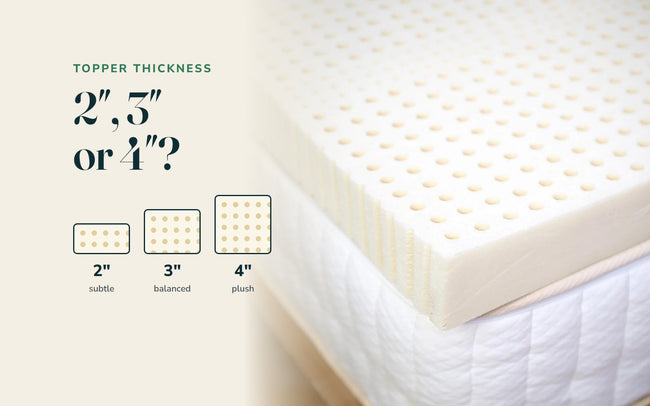
- Toppers: a topper adds its own thickness to the bed. A 10-inch mattress with a 3-inch topper is 13 inches tall. Our mattress topper thickness guide helps you choose 2, 3 or 4 inches.
- Fitted sheets: pick a pocket depth at least as deep as your mattress plus topper, ideally an inch or two deeper so the corners stay put. Our bed sheet size guide explains how to measure.
- Protectors: choose a mattress protector made for your mattress depth so it doesn't pull the corners up.
Tip
Measure mattress depth from the top edge straight down to the bottom edge, not over the curve of the top. A pillow top or quilted cover can add an inch or more to the listed thickness.
What Is the Biggest Factor to Consider Besides Mattress Thickness?
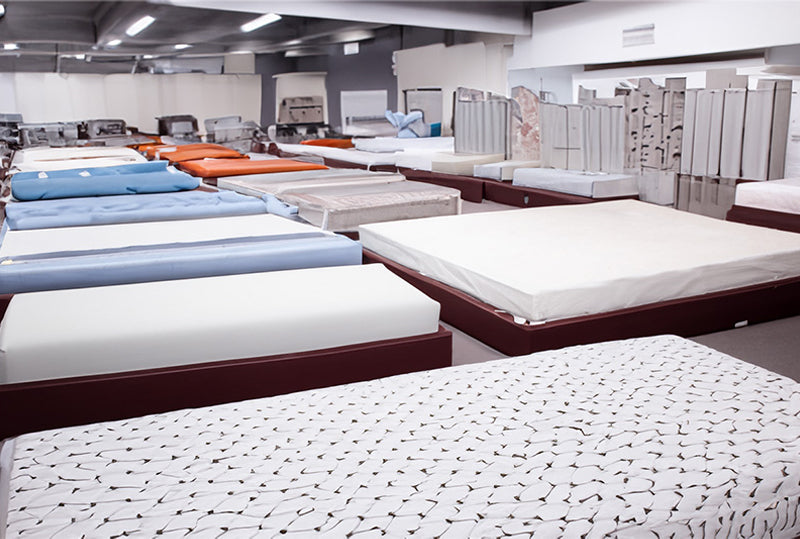
Mattress type is one of the biggest factors besides thickness. You'll find poly foam, memory foam, all-latex, innerspring, hybrid mattresses and air mattresses, and two mattresses of the same thickness can feel completely different.
All-latex and foam
An all-latex mattress, like the 7 Zone latex mattress, or a memory foam mattress contours closely for cushioning and pressure relief. Latex feels springy and responsive, while memory foam responds slowly. See latex vs. memory foam.
Innerspring and hybrid
Coil mattresses, including innerspring and hybrid designs, give more bounce and airflow. A hybrid tops the coils with comfort layers, such as latex, for more cushioning.
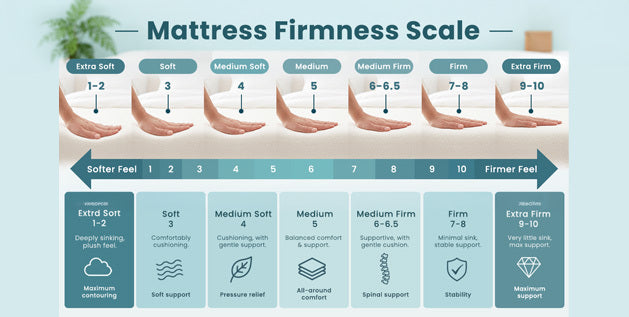
Firmness is the other big choice. A thick mattress can be firm and a thin one can be soft, so pick both together; our mattress firmness scale explains the levels. Whichever type you choose, buy from a seller who tells you exactly what's inside and offers a real trial, because a low-quality mattress often lets you down on comfort and durability.
Good to know
Every Turmerry mattress comes with a 365-night trial (sleep on it at least 30 nights first) and free shipping in the contiguous US, and most orders ship the same business day from Charlotte, NC. Sleep Foundation named the Dual Side Flippable "Best Mattress for Pressure Relief" in 2026, with an 8.9/10 score. Sleep Foundation may have an affiliate relationship with Turmerry.
Frequently Asked Questions

SHOPPING FOR A NEW MATTRESS?
Choose 7, 10 or 12 inches and swap layers to change the feel. 365-night trial, free pillows with every mattress.
$719.20 $899.00From. Code BF20 is added at checkout.
Get exclusive offers by email
Sale alerts and new sleep guides. Unsubscribe anytime.
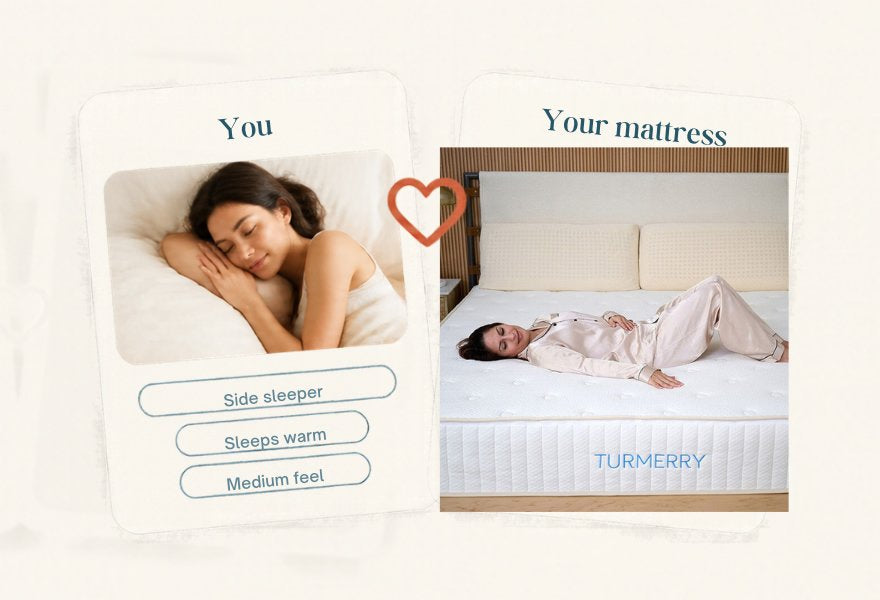
Shop what's in this guide
 7 Zone Organic Latex Mattress$719.20
 7 Zone Latex Mattress Topper$84.15
 Organic Waterproof Mattress Protector$50.15
 Organic Latex Pillow$83.30
Starting prices. Sale codes BF20 and BF15 are added at checkout.
Disclaimer: What is said in this article has been referenced from multiple sources and is intended only for educational and informational purposes. Please note that no content in this article is a substitute for professional advice from a qualified doctor or healthcare provider. Always consult an experienced doctor with any concerns you may have regarding a health condition or treatment, and never disregard any medical suggestions or delay in seeking treatment because of something you read here.
