No Products in the Cart
How to Get Pee Smell Out of Mattress?
Written by Chinmay Shankar

Last Updated November 5, 2026
Whether it's a potty-training slip, a pet accident or a long night, finding urine on your mattress is no fun. The good news is that most pee stains and smells come out with a few things you probably already have at home, as long as you blot it up, clean gently and dry the mattress completely. Here's how to get pee smell out of a mattress, whether the accident happened five minutes ago or five weeks ago.
Quick answer
Blot, clean lightly, deodorize, dry. Strip the bed and blot up as much urine as you can with dry towels (don't rub). Lightly mist the spot with equal parts white distilled vinegar and cool water, blot again, then cover it with baking soda and leave it for at least 8 hours, or overnight. Vacuum it up and let the mattress dry completely before you remake the bed. Dried or pet urine may need two or three rounds. On a latex mattress, skip hydrogen peroxide and don't wash the layers or the zip cover; on other mattresses, test any enzyme cleaner or peroxide on a hidden spot first.
Key Takeaways:
- Act fast. Fresh urine is mostly liquid and comes out much more easily than urine that has dried into the mattress.
- Blot, don't rub, and use cool water. Rubbing spreads urine deeper, and hot water can set the stain.
- White vinegar and water plus baking soda (left for 8 hours or overnight) handles most fresh accidents on any mattress type.
- Dried and pet urine often need repeat treatments. Enzyme cleaners and 3% hydrogen peroxide are options for memory foam and innerspring mattresses after a patch test, but not for latex.
- Never soak the mattress, and don't sleep on it until it's completely dry, inside and out.
- A waterproof mattress protector is the easiest prevention. It catches accidents at the surface so you wash the protector, not the mattress.

Kids and pets love a cozy bed just as much as we do. Little ones who are potty training, kids who still wet the bed now and then, and pets who sneak onto the mattress all make accidents a normal part of life. And accidents can happen at any age. None of it is anyone's fault, and none of it has to ruin your mattress.
A waterproof mattress protector catches most accidents before they reach the mattress, so it's the first thing to check. But kids and pets move around, protectors get taken off for washing, and sometimes urine finds its way through anyway. That's when you need the steps below.
Pets bring their own challenge. Cat and dog urine is usually more concentrated, darker and stronger-smelling than human urine, and an animal that smells an old accident may go back to the same spot. That's why getting the smell out completely, not just the stain, matters so much with pets.

How Do I Get Rid of the Human Urine Smell?
Fresh human urine is mostly water, so a new accident is mainly a moisture problem: get the liquid out quickly and there's often little stain or smell left. The trouble starts when urine dries. The water evaporates, the residue stays in the fabric and padding, and as it breaks down it gives off that sharp, ammonia-like smell you notice long after the spot looks dry.
That's why the method depends on how old the accident is:
| Type of accident | What's going on | What usually works |
|---|---|---|
| Fresh urine (still wet) | Mostly liquid, sitting in the top layers | Blot right away, vinegar and water, baking soda for 8 hours, dry completely |
| Dried urine (hours to weeks old) | Residue has settled into the fabric and padding, with a yellow ring and a stronger smell | Repeat the vinegar and baking soda method two or three times; on non-latex mattresses, an enzyme cleaner or 3% peroxide after a patch test |
| Pet urine | More concentrated, stronger smell, often in the same spot again | Blot hard, treat the smell thoroughly, repeat until it's gone so the pet isn't drawn back |
| A large or repeated soaking | Urine may have reached the deeper layers | Unzip the cover if you can and check inside; see "When the smell won't go away" below |
Whatever your mattress is made of, a traditional innerspring, memory foam, a latex mattress or a latex mattress topper, deal with a pee stain promptly. Moisture that sits in a mattress makes odors harder to remove and can lead to musty smells or mildew.
Tip: finding the spot
Not sure exactly where the accident happened? Look for a visible ring, press a dry paper towel onto suspect areas to check for damp, and do a quick sniff test. For old, faded stains, switch off the lights and shine a UV (black light) flashlight over the mattress: dried urine often shows up as a glowing patch. Mark the edges with a piece of chalk so you know where to clean.

Can You Save a Mattress That Was Peed On?
Yes, in most cases. A single accident that you blot up and clean properly rarely means replacing a mattress. The sooner you start, the easier it is, so if you can, deal with it before the urine dries.
-
Strip the bed
Take off the sheets, any blanket or mattress pad, and the mattress protector. If you have a waterproof protector, it has probably caught most of the urine, and the mattress underneath may be dry.
-
Check how far it went
Press a dry paper towel onto the mattress to see if it's damp, and check the sides. If your mattress has a zippered cover, like Turmerry latex mattresses, unzip it and look at the layers inside.
-
Wash the bedding
Machine-wash the sheets and protector as soon as you can, following their care labels. Cool or warm water is better than hot for fresh urine, and adding about a cup of white vinegar to the wash can help with lingering smells (check the label first). Air-dry or tumble on low as the label says.
-
Treat the mattress
If the urine reached the mattress, follow the fresh-urine steps below, or the dried-urine steps if it has already dried.
Careful: don't wash a mattress zip cover
On a Turmerry latex mattress, the zippered cover that holds the layers is spot-clean only. Our latex mattress care instructions say: "Avoid washing any of the layers or the cover. They should not be placed in a dryer." Many other mattress covers aren't washable either, so check the label before you take one off and put it in the machine.
Will the Urine Smell Ever Go Away?
Yes. In most cases you can get both the stain and the smell out and keep using your mattress. Fresh accidents usually need one round of cleaning; dried and pet urine may need two or three. Gather your supplies first so you can work quickly.
| Supply | What it's for |
|---|---|
| Clean, dry towels or paper towels | Blotting up as much urine as you can |
| White distilled vinegar and a spray bottle | A light mist of equal parts vinegar and cool water to help with the smell |
| Baking soda | Drawing out leftover moisture and absorbing odors |
| Vacuum with a soft brush or upholstery attachment | Removing the baking soda |
| Mild, dye-free detergent (optional) | Lifting a visible stain |
| Gloves | Keeping your hands clean, especially with pet urine |
| A fan or dehumidifier (optional) | Speeding up drying |
How to Get Rid of Fresh Urine Stains
No need to panic. If it's still wet, you can usually get rid of both the stain and the smell in one go.
-
Blot up the urine
Press dry towels or a stack of paper towels firmly onto the wet spot and hold them there, swapping in fresh ones until they come away barely damp. Don't rub or scrub: that pushes urine deeper and spreads it.
-
Mist with vinegar and water
Mix equal parts white distilled vinegar and cool water in a spray bottle, and lightly mist the area. You want it damp, not wet. The vinegar smell fades as it dries.
-
Blot again
Press a clean, dry towel onto the area to lift out the solution along with more of the urine. If a visible stain remains, dab it from the outside in with a cloth dampened in cool water and a drop of mild detergent, then blot with a cloth dampened in plain water.
-
Cover it with baking soda
Sprinkle a generous layer of baking soda over the whole area, a little wider than the stain. Leave it for at least 8 hours, or overnight, in a well-ventilated room. If the baking soda darkens or clumps, it's soaking up moisture; that's a good sign.
-
Vacuum and check
Vacuum up the baking soda with a soft brush attachment, then check for any stain or smell. If you can still smell urine, repeat steps 2 to 5.
-
Let it dry completely
Leave the bed uncovered until every part is dry, using a fan if you have one. Don't remake the bed or sleep on it while it's still damp.
Did the stain go? If the urine was fresh, that's usually all it takes. Older and pet stains need a little more work.
How to Get Rid of Tough Pet Urine Stains
Dog and cat urine is usually more concentrated than human urine, so the smell is stronger and harder to shift. Getting every trace of it out matters, because a pet that can still smell an old accident may treat the spot as fair game.
Start with the same basics: plenty of towels, vinegar and water, baking soda and a vacuum. Blot harder than you would for a fresh human accident, pressing your weight into the towels until no more liquid comes up. Then work through the fresh-urine steps above, and repeat them until the smell is completely gone.
Good to know: enzyme cleaners
Enzyme cleaners, sold for pet stains and laundry pre-treatment, contain enzymes designed to break down the organic compounds in urine, and many pet owners use them for stubborn smells. If you want to try one on a memory foam or innerspring mattress, test it on a small, hidden spot first, use as little as the label allows, give it the time the label suggests, and blot it out with a cloth dampened in cool water. On a Turmerry latex mattress, stick to the vinegar, water and baking soda method from our care instructions instead.
Lingering smells can also travel to your bedding and pillows. If you use a buckwheat pillow, for example, empty the hulls into a clean container, wash the pillowcase following its care label, and let the hulls air out before you refill it.
How to Keep Pets From Peeing on Your Mattress
Once the smell is gone, a few habits help stop a repeat:
- Clean thoroughly. Any smell your pet can still detect may draw them back, so keep going until you can't smell anything.
- Keep the bedroom door closed while you're out, or while a new pet is still learning the house rules.
- Stick to a routine. Regular walks, a clean litter box in a quiet spot and consistent house training go a long way.
- Use a waterproof protector so any accident that does happen stays on the surface.
- Ask your vet if a house-trained pet suddenly starts having accidents. It can have many causes, from stress or a change at home to something your vet should look at.
How to Get Rid of Old Stains or Dried Pee
The number one rule is not to let urine sit. But if you've found an old, dried stain, it's still worth treating, and you don't need professional cleaners for a small spot.
First, find the full extent of the stain with a black light and mark it with chalk. Put on gloves, and gather baking soda, white vinegar, a spray bottle, clean cloths and a soft brush or old, clean toothbrush.

-
Loosen the dried residue
Lightly mist the stain with equal parts white vinegar and cool water. For a visible ring, you can add a few drops of mild detergent to 2 cups of cool water and 1 cup of white vinegar instead. Let it sit for 5 to 10 minutes, without soaking the mattress.
-
Work it gently and blot
Dab the area, or brush it very gently with a soft brush, working from the outside of the stain toward the center. Then blot firmly with a dry towel to lift the moisture out.
-
Add baking soda
Cover the area with a generous layer of baking soda and leave it for at least 8 hours, or overnight, in a well-ventilated room.
-
Vacuum and repeat
Vacuum it up and check. Old stains often need two or three rounds, so repeat on another day if the smell or ring is still there.
-
Dry it completely
Let the area dry all the way through before you remake the bed.
Still there, on a memory foam or innerspring mattress? Two stronger options are an enzyme cleaner (see above) or 3% hydrogen peroxide. A common mix is 1 cup of 3% hydrogen peroxide, 3 tablespoons of baking soda and a drop of dish soap. Mix it fresh, use it right away and don't store it in a closed bottle. Peroxide can lighten colored fabric, so use it only on white or light covers, test it on a hidden spot first and wait a few minutes to check for fading. Dab it on with a cloth rather than spraying it heavily, let it dry for 8 to 10 hours, then vacuum up any residue.
Careful: no peroxide on latex
Hydrogen peroxide is a popular stain remover, but Turmerry's latex mattress care instructions say to avoid it. On any mattress, skip chlorine bleach, ammonia-based cleaners (they can smell like urine to a pet), and mixing different cleaners together. Don't cover a wet spot in plastic wrap either: trapping moisture in a mattress can lead to musty smells and mildew.
When the Smell Won't Go Away
If the smell keeps coming back after several rounds of cleaning and thorough drying, the urine has probably soaked deep into the padding, foam or latex. With a one-piece mattress, that may mean it's time to replace it. With a zippered latex mattress, check the layers inside: often only the cover or the top layer was affected. If you have a Turmerry mattress or topper, contact us with photos of the cover and layers, and we'll help you work out the next step.
How to Clean Pee Out of Different Mattress Types
The basic method, blot, vinegar and water, baking soda, dry, works on every mattress. What changes is how much liquid the material can take and which stronger cleaners are safe on it. Always check your mattress's care label first.
| Mattress type | Use | Avoid | Drying |
|---|---|---|---|
| Latex (including Turmerry) | Blot, a light mist of white distilled vinegar and water, baking soda for 8 hours, vacuum. Unzip the cover to check the layers. | Hydrogen peroxide, bleach, harsh cleaners, soaking, steam, washing the layers or the zip cover, the dryer | Indoors with airflow, out of direct sun; don't use it until it's completely dry |
| Memory foam | Very little liquid: vinegar and water, baking soda; an enzyme cleaner or 3% peroxide only after a patch test | Soaking, steam cleaning, heat, bleach | Fans and time; foam holds moisture, so allow longer |
| Innerspring or hybrid | Same as memory foam; treat the quilted top, which absorbs most of the urine | Over-wetting (moisture can reach the inner layers), steam, bleach | Stand it on its side with a fan on both faces |
Latex mattresses
Turmerry's latex mattresses are separate layers inside a zippered organic cotton cover, which makes accidents easier to deal with: you can unzip the cover and see exactly how far the urine went. Our care instructions for liquid spills are: "Soak up the spilled liquid, spray the affected area with a mixture of white distilled vinegar and water (or lemon juice), sprinkle some baking soda over the mattress, and let it rest in an area with ventilation. After 8 hours, remove the baking soda with a vacuum, check for any odor or stain, and let the mattress dry entirely before putting it back."
If urine reached a latex layer, lift it out with both hands, supporting it underneath, and let it air-dry on its own in a well-ventilated room, out of direct sunlight. Spot clean the cover rather than washing it. Our guides on how to care for your latex mattress and how to dry a wet mattress go into more detail. For a topper, see how to get stains out of a mattress topper.
Memory foam mattresses
Memory foam soaks up liquid like a sponge and dries slowly, so use as little liquid as you can. Blot hard, mist lightly, and rely on baking soda and airflow to do the rest. If the cover unzips, check its label: some are machine washable, many aren't.
Innerspring and hybrid mattresses
Most urine stays in the quilted comfort layers on top, so that's where to focus. Avoid pouring on cleaner, which can carry moisture down toward the springs, and stand the mattress on its side with a fan running so air reaches both faces while it dries.
Bedwetting and Potty Training: Tips for Parents
Night-time accidents are a normal part of growing up, and plenty of kids wet the bed now and then well after they're potty trained. Keeping things calm and low-key helps everyone get back to sleep faster.
- Double-make the bed. Layer a waterproof protector, a fitted sheet, a second protector and a second fitted sheet. After an accident, peel off the top two layers and the bed underneath is ready to go.
- Keep a night kit handy: spare pajamas, a towel and a clean sheet within reach, so a middle-of-the-night change takes a couple of minutes.
- Wash the bedding promptly instead of letting it sit in a hamper, which makes smells harder to remove.
- Keep it matter-of-fact. A quick, kind clean-up with no fuss is easier on everyone.
Both Turmerry waterproof protectors come in a crib size, as well as Twin through Cal King. In a crib, use a fitted protector under a fitted sheet and nothing else: the American Academy of Pediatrics recommends keeping loose blankets, pillows and soft toys out of an infant's sleep space for the first 12 months. If you have questions about your child's bedwetting, your child's doctor is a good person to ask.
What Not to Use on a Peed-On Mattress
Do
- Act quickly and blot, pressing and lifting
- Use cool water, white vinegar and water, and baking soda
- Work from the outside of the stain in
- Test any stronger cleaner on a hidden spot first
- Keep the mattress damp, never soaked
- Dry it completely, with airflow, before you remake the bed
Don't
- Rub or scrub hard, which spreads urine deeper
- Use hot water or a steam cleaner, which can set the stain
- Use bleach, ammonia, or mix different cleaners
- Use hydrogen peroxide on latex
- Wrap a wet spot in plastic or remake the bed while it's damp
- Dry latex in direct sun, or put latex layers or a zip cover in a dryer
You may see essential oils, rubbing alcohol or borax suggested elsewhere. We'd leave them out: they don't remove urine, some can mark fabrics, and strong scents can bother pets. Baking soda absorbs odors without adding a new one.
How to Keep Pee From Reaching Your Mattress
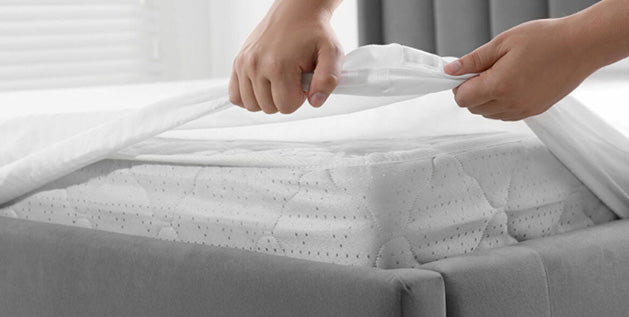
The easiest way to deal with urine is to stop it at the surface. A waterproof mattress protector catches accidents, spills and sweat, so most "mattress cleaning" becomes a trip through the washing machine. Turmerry has two in-stock options, both in Crib, Twin, Twin XL, Full, Queen, King and Cal King:
Organic Waterproof Mattress Protector
The Organic Waterproof Mattress Protector has a GOTS certified organic cotton jersey top with a thin, plant-based waterproof layer made from non-GMO cornstarch. It's thin and quiet, so it doesn't change how your mattress feels.
- Crib size for little ones
- Machine wash with a mild detergent; tumble dry or hang to dry, away from high heat
Wool Waterproof Mattress Protector Pad
The Wool Waterproof Mattress Protector Pad puts a layer of washable wool under a cotton percale top, with a waterproof backing that covers the top and all four sides.
- Also available in Crib size
- Machine washable in a front-load washer; dry on low heat
Wash your protector after any accident, and every 1 to 2 months otherwise. Keep it away from high heat, which can damage the waterproof layer. See how to wash a mattress protector for the details.
If you have a Turmerry mattress
Our mattress warranty says "a compatible waterproof mattress protector must be used from day one," and it doesn't cover a mattress with stains, spills, dampness or mold. A protector keeps your mattress clean and your coverage intact.
Conclusion
Prevention is the best fix: a waterproof protector from day one, and a dry towel handy for when accidents happen. When urine does reach the mattress, act quickly. Blot it up, mist with vinegar and water, leave baking soda on for at least 8 hours, vacuum, and let it dry completely. Old and pet stains may take a few rounds, and stronger cleaners are only for memory foam and innerspring mattresses after a patch test, never peroxide on latex. For blood or other stains, see how to get blood out of a mattress.
Questions about cleaning a Turmerry mattress or topper? Call us at 984-299-6850 or contact us here, and we'll be happy to help.
Quick checklist
- Strip the bed and wash the sheets and protector
- Blot with dry towels; don't rub
- Mist with equal parts white vinegar and cool water, then blot again
- Baking soda for at least 8 hours, or overnight; vacuum
- Repeat for dried or pet urine
- Non-latex only: enzyme cleaner or 3% peroxide after a patch test
- Dry completely before you remake the bed
- Put on a waterproof protector to stop the next one
Frequently Asked Questions

PROTECT YOUR MATTRESS
Organic Waterproof Mattress Protector
GOTS certified organic cotton with a waterproof barrier that still breathes. Machine washable, crib to split king.
$50.15 $59.00From. Code BF15 is added at checkout.
Early Access Black Friday Sale: 15% offOrganic Waterproof Mattress Protector
$50.15 $59.00From, with BF15
Get exclusive offers by email
Sale alerts and new sleep guides. Unsubscribe anytime.
Shop what's in this guide
 7 Zone Organic Latex Mattress$719.20
 7 Zone Latex Mattress Topper$84.15
 Organic Waterproof Mattress Protector$50.15
 Organic Latex Pillow$83.30
Starting prices. Sale codes BF20 and BF15 are added at checkout.

Disclaimer: What is said in this article has been referenced from multiple sources and is intended only for educational and informational purposes. Please note that no content in this article is a substitute for professional advice from a qualified doctor or healthcare provider. Always consult an experienced doctor with any concerns you may have regarding a health condition or treatment, and never disregard any medical suggestions or delay in seeking treatment because of something you read here.
