No Products in the Cart
How to Measure a Mattress
Written by Zulekha Nishad

Last Updated November 6, 2026
Buying new sheets, a topper, a bed frame or planning a move? It all starts with three numbers: your mattress's width, length and thickness. This guide shows you how to measure a mattress accurately, how to match the numbers to a standard size, and how to measure for sheets, frames, doorways and even a warranty claim.
Quick answer
Strip the bed, then use a metal tape measure to measure the width (side to side), the length (head to foot) and the thickness (bottom edge to top edge, straight down the side). Measure across the middle, not the rounded corners, and have a second person hold the tape straight. Standard US sizes are Twin 38 x 75 inches, Twin XL 38 x 80, Full 54 x 75, Queen 60 x 80, King 76 x 80 and California King 72 x 84. A real mattress can measure up to about an inch off those numbers, so check the maker's spec if you're unsure.

Key Takeaways:
- Measure width, length and thickness on the bare mattress, across the middle, with a metal tape held straight and level.
- Match your width and length to the nearest standard size: 38, 54, 60, 72 or 76 inches wide, and 75, 80 or 84 inches long.
- Mattresses can be up to about an inch off their listed size. Round to the nearest half inch and check the maker's spec.
- For fitted sheets, add mattress, topper and protector heights, then choose a pocket 1-2 inches deeper than the total.
- Before a move, measure doorways, halls and stairs too. Never fold or bend a latex mattress or topper to make it fit.
Why Measure a Mattress's Dimensions?
Most of what goes on, under or around your mattress is sold by size, and "queen" or "king" on its own isn't always enough. Measuring tells you:
- Which standard size you have, if the label is missing or you inherited the bed.
- How deep your fitted sheets and protector need to be, since mattress thickness isn't standardized.
- Which bed frame, foundation or headboard fits, and how high the bed will sit.
- Whether it will get through your doors and up the stairs on moving day, and which mattress bag to buy.
- Whether a dip is deep enough for a warranty claim, which needs its own kind of measurement (see below).
How to Measure the Dimensions of a Mattress
You only need a few simple things:
- A metal tape measure with a hooked end, at least 8 feet (96 inches) long. A steel tape stays straight across a wide mattress, while a cloth tape can sag and read long.
- A helper. One person holds the hook end; the other reads the tape. It's much more accurate than stretching across a king on your own.
- A pen and paper, or your phone, to note each number.
- A flexible tailor's tape and a straight edge, only if you're measuring a dip for a warranty claim.
-
Strip the bed
Take off the pillows, blankets, sheets, protector and any topper, so you're measuring the bare mattress. Bedding adds bulk and throws the numbers off.
-
Measure the width
Hook the tape on one long side and run it straight across the top to the other side. Measure across the middle of the mattress rather than at the head or foot, since corners are often rounded. Keep the tape flat on the surface and square to the edges.
-
Measure the length
Hook the tape at the head and run it down the center to the foot. Again, measure through the middle, not along a rounded corner. The length is always the longer side (or the same as the width on a square bed).
-
Measure the thickness
Hold the tape upright against the side of the mattress, in the middle of a long side, and measure from the bottom edge to the top edge. Keep the tape vertical, and don't include the box spring, foundation or frame. On a pillow-top or quilted cover, measure to the top of the cushioned surface.
-
Round and compare
Write down each number, rounded to the nearest half inch, then compare the width and length with the size chart below. The closest standard size is almost certainly yours.

Length
Head to foot, the longer side. It decides how tall a sleeper can stretch out: 75, 80 or 84 inches on standard US sizes.

Width
Side to side, the shorter side. It decides how many people fit comfortably: from 38 inches on a twin to 76 inches on a king.

Thickness
Bottom edge to top edge, also called depth or height. It sets the pocket depth your sheets need. Most mattresses are 8-12 inches thick.
Careful with latex
Measure a latex mattress or topper where it lies. Don't fold back, bend or lift a corner to get the tape under it, and don't pull a latex layer by its edge. Turmerry's mattress warranty excludes "Issues caused by bending, folding, jumping, dragging, abusing, neglecting, or mishandling the mattress."
How Accurate Do Your Measurements Need to Be?
Close is good enough. Mattresses are made from soft, compressible materials, so a new mattress can measure up to about an inch off its listed size, and covers, quilting and rounded edges all nudge the numbers. A queen might measure 59 1/2 x 79 1/2 inches, for example, and still be a standard 60 x 80 inch queen that fits queen sheets and frames.
- Round to the nearest standard size. If your mattress is within about an inch of a size in the chart, that's your size.
- Check the maker's spec. The product page, law tag or order confirmation usually lists the size and height. If your measurement is well outside it, contact the maker.
- Thickness includes the cover. Turmerry lists mattress heights with the cover included. On the 10-inch 7 Zone Organic Latex Mattress, for example, that's three 3-inch latex layers plus the 1-inch organic cotton cover.
- A thick crown can read high. A pillow-top or plush top may measure taller in the middle than at the edge. For sheets, use the taller number.
Good to know
Measuring isn't how you check a sag. Width, length and thickness are taken along the edges and across the top; a dip is measured from a straight edge with no weight on the bed. We cover that in the warranty section below.
Common Mattress Sizes and Their Dimensions
Once you have your numbers, match them to the closest size below. Dimensions are width x length.
 28 x 52"
Crib
A full-size crib mattress is about 28 x 52 inches. US rules set the minimum at 27 1/4 x 51 5/8 inches, so it fits the crib snugly, and it's usually no more than 6 inches thick. Use only a fitted sheet in the crib. See our kids mattress size guide.
 38 x 75"
Twin
Also called a single. The usual first big-kid bed and the standard for bunk beds and daybeds. At 75 inches (6'3") long, it suits kids, teens and single adults under about 6 feet. Shop twin mattresses.
 38 x 80"
Twin XL
The same width as a twin but 5 inches longer, the same length as a queen or king. It's the standard size in most college dorms, and two twin XLs side by side make a king. Shop twin XL mattresses.
 54 x 75"
Full
Also called a double. 16 inches wider than a twin with the same length, so it's roomy for one adult. Two people can share it, but each gets only 27 inches of width. Shop full mattresses.
 60 x 80"
Queen
The most popular size in the US. Each of two sleepers gets 30 inches of width, and the 80-inch length (6'8") suits most adults. Shop queen mattresses.
 76 x 80"
King
Also called an Eastern king. The widest standard size, 16 inches wider than a queen, with room for a couple plus a child or pet. It needs about a 12 x 12 foot room. Shop king mattresses.
 72 x 84"
California King
4 inches narrower and 4 inches longer than a king, making it the longest standard size, a good fit for sleepers over 6 feet tall. Compare them in our king vs California king guide. Shop California king mattresses.
 2 x 38 x 80"
Split King
Two halves the size of a twin XL (38 x 80 inches each) that together make a standard 76 x 80 inch king, so each sleeper can choose their own firmness. Measure the whole bed as a king. Shop split king mattresses.
Split sizes at Turmerry
Turmerry's split latex mattresses come in one zippered organic cotton cover the full size of the bed, with two side-by-side sets of latex layers inside. Measure and buy for the whole bed: a split queen takes regular queen sheets and protectors, a split king takes king sizes, and a split California king takes Cal king sizes. Each half is 30 x 80 (split queen), 38 x 80 (split king) or 36 x 84 inches (split Cal king).
Want each size in feet, centimeters and minimum room size? Our mattress size chart has all of it, and the international mattress size guide covers UK, European and other sizes.
Measuring for Bedding Accessories
Sheets, protectors, toppers, blankets, duvets and comforters are all sold by mattress size, but they don't all use the same numbers. Width and length tell you the size; thickness tells you how deep the fitted pieces need to be.
Fitted sheets and protectors: pocket depth
A fitted sheet's pocket has to wrap the full height of everything under it: the mattress, plus any topper, plus the protector. Add them up, then choose a pocket 1-2 inches deeper than the total so the corners tuck under and stay put. If your topper is already on the bed, you don't need to take it off: measure straight up from the bottom edge of the mattress to the top of the topper.
8-12"Typical mattress thickness
+2-4"Added by most mattress toppers
+1-2"Extra pocket depth to aim for
15"Pocket on Turmerry's organic waterproof protector
| Total bed thickness | Pocket depth to look for | Example |
|---|---|---|
| 8-12 inches | About 12-15 inches | A 10" mattress with no topper |
| 12-15 inches | About 15-17 inches ("deep pocket") | A 12" mattress, or a 10" mattress with a 2-3" topper |
| 15-18 inches | About 18-22 inches ("extra deep") | A 12" mattress with a 3-4" topper |
| Over 18 inches | 22 inches or more | Tall pillow-top mattresses with a topper |
For example, a 10-inch mattress with a 3-inch topper is 13 inches tall, so you'd want a fitted sheet with a pocket of about 14-15 inches or more. Turmerry's organic waterproof mattress protector fits like a fitted sheet, with 15-inch pockets and elastic all around, in sizes from Crib to Split King. Our bed sheet size guide has the full chart for sheets.
Toppers and topper covers
A topper should match your mattress's width and length exactly. If yours measures between sizes, go by the standard size it rounds to, not the raw number. Turmerry's latex toppers come in 2, 3 and 4 inch thicknesses, and the Mattress Topper Cover comes in 2" and 3" depths, Twin to Cal King, to fit them.
Blankets, duvets and comforters
Top-of-bed pieces don't need an exact fit. They're cut wider and longer than the mattress so they drape over the sides, and a thicker mattress or a topper takes up more of that overhang. If your bed is tall, look at the next size up. You'll find organic options in our bedding, blankets and wool comforters collections, and sizes in our comforter size guide.
Measuring for a Bed Frame or Foundation
A bed frame or foundation is sold by mattress size, but the frame itself is bigger than the mattress. A frame's outside dimensions are usually a few inches wider and longer, while the inside, where the mattress sits, should match your mattress closely.
-
Measure inside the rails
On a frame with side rails, measure the inside width and length where the mattress sits. It should be the mattress size or very slightly bigger. A gap of more than an inch or two lets the mattress shift and leaves a space at the edges.
-
Check the slats
Measure the gaps between slats. Turmerry's warranty asks for "A slatted frame with slats spaced no more than 3 inches apart," and for Queen, King and California King "a center rail and dedicated center support leg(s) to prevent sagging."
-
Work out the bed height
Add the height of the frame's mattress deck to your mattress thickness (and any topper). That's your sleeping height. On a bunk or loft bed, also check that the guardrail rises well above the mattress; the bed's label lists the maximum mattress thickness.
-
Leave room around the bed
Measure the room too, allowing about 2 feet of clearance on the sides and at the foot. Our bed frame size chart lists typical frame dimensions for each size.
Box springs and latex
A box spring is made to go under an innerspring mattress. Latex mattresses need firm, even support instead: a solid platform, close-set slats or a properly configured adjustable base. Turmerry's warranty states, "Using an improper foundation, such as a box spring, or placing the mattress directly on the floor, will void the warranty." See our guide to the best foundation for a latex mattress.
Turmerry Mattress Sizes and Thicknesses
If you own (or are choosing) a Turmerry mattress, here are the listed heights, with the cover included. Use them for sheet pocket depth and bed height.
| Mattress | Thickness | Sizes |
|---|---|---|
| 7 Zone Organic Latex Mattress | 7, 10 or 12 inches | Twin to California King, plus Split Queen, Split King and Split Cal King |
| Dual Side Latex Flippable | 7 inches | Twin to California King |
| Organic Egg Crate Mattress | 10 or 12 inches | Twin to California King, plus Split Queen and Split King |
| Bigg+ Natural Latex Mattress | 12 inches | Twin XL, Queen, King and Cal King |
| DIY Hybrid Mattress With Latex | 10 or 12 inches | Twin to King, plus Split Queen and Split King (one cover and coil unit, split latex) |
| Organic Latex Hybrid Mattress | 11 inches | Twin to California King |
| Organic Kids Mattress | 7 inches | Twin, Twin XL and Full |
So a 12-inch Bigg+ or 7 Zone with a 2-inch topper is about 14 inches tall and fits a 15-inch pocket, while the same mattress with a 4-inch topper needs a pocket of 17 inches or more. For more on choosing a height, see our mattress thickness guide.
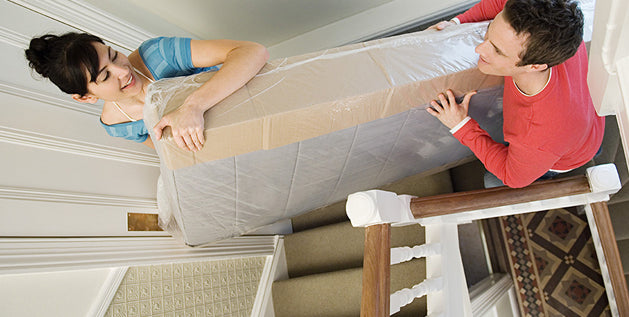
Measuring Doorways and Stairs Before a Move
Moving a mattress, or bringing a new one home? Measure the route as well as the mattress. The usual sticking points are tight hallway turns, narrow stairs and low ceilings over a staircase, not the front door.
-
Measure each doorway
Open the door fully and measure the clear opening width and height. The door and hinges usually take up an inch or two. Most interior doors in the US are about 80 inches tall.
-
Check how the mattress will pass through
A mattress is usually carried upright on its long edge, so its thickness has to clear the door's width and its width has to clear the door's height. A 60-inch queen stands well under an 80-inch door; a 76-inch king is a much tighter fit and may need to be tilted.
-
Measure halls, stairs and landings
Measure the width of hallways and stairs, the ceiling height above the stairs, and any turn or landing. An 80-inch mattress needs room to swing around a corner.
-
Get two people and the right bag
Use your mattress measurements to buy a mattress bag one size up. Carry anything bigger than a twin with two people, and see our full guide on how to move a mattress.
Don't bend it to fit
Never fold, bend, roll or squeeze a latex mattress or topper through a tight spot. On a Turmerry zip-cover latex mattress, unzip the cover and move the layers one at a time, kept flat or on edge, so even a king goes through a standard door. The Organic Latex Hybrid is one piece, so move it like any hybrid, with two people. For other brands, bend a mattress only if the maker allows it.
How to Measure a Sag for a Warranty Claim
A dip or body impression is measured differently from the mattress size. Mattress warranties set a minimum depth before an indentation counts as a defect, and they say how to measure it. Turmerry's warranty covers "Indentations or imprints greater than 1.5 inches, measured without any weight on top of the mattress using a flexible tailor-type tape." For Turmerry toppers, the threshold is "greater than 1 inch."
-
Take everything off
Remove the sheets, protector and any topper, and make sure no one is on the bed. The measurement only counts with no weight on top.
-
Lay a straight edge across the dip
Rest a broom handle, a long level or another straight edge across the mattress over the deepest part of the dip, so both ends sit on the flat surface either side.
-
Measure the gap with a tailor's tape
Use a flexible tailor-type tape to measure straight down from the straight edge to the mattress at the deepest point. Don't press on the mattress while you measure.
-
Photograph it
Turmerry's warranty asks for "Measurement images taken using a tailor's tape for body impressions," along with photos of the defect, the overall mattress surface, the support foundation and the law tag, plus proof of purchase.
-
Check the base first
Look for cracked slats, gaps wider than 3 inches or a missing center support. A dip that lines up with a weak spot in the base is usually a base problem, not a mattress defect.
Our guide on whether natural latex mattresses sag explains what the results mean and how to fix each cause. On a Turmerry zip-cover mattress, you can also unzip the cover to see whether one layer has softened or the layers have simply shifted.
Not-So-Common Mattress Sizes
Beyond the standard sizes, you'll come across a few others. Some are regional, some are made for RVs and campers, and the very large "family" sizes are custom or specialty beds that usually need their own frames and bedding.
- Longer or wider versions of standard sizes: Full XL, California Queen and Olympic Queen add a few inches to a full or queen.
- RV sizes: RV beds use their own short and narrow sizes, such as the Short Queen, RV King and RV Bunk. Measure an RV bed carefully, since "RV king" can mean several different sizes. See our RV mattress size guide.
- Oversized family beds: the Wyoming King, Texas King and Alaskan King are custom or specialty sizes you'll rarely find in stores. Our biggest bed size guide compares them.
- International sizes: a UK super king, for example, is 180 x 200 cm (about 70.9 x 78.7 inches), smaller than a US king.
All Mattress Dimensions
Here are the standard and not-so-common mattress dimensions in one place, width x length. Centimeters are rounded to the nearest whole number.
| Mattress size | Inches (W x L) | Feet and inches (W x L) | Centimeters (W x L) |
|---|---|---|---|
| Crib | 28 x 52 in | 2'4" x 4'4" | 71 x 132 cm |
| Twin | 38 x 75 in | 3'2" x 6'3" | 97 x 191 cm |
| Twin XL | 38 x 80 in | 3'2" x 6'8" | 97 x 203 cm |
| Full | 54 x 75 in | 4'6" x 6'3" | 137 x 191 cm |
| Full XL | 54 x 80 in | 4'6" x 6'8" | 137 x 203 cm |
| Short Queen (RV) | 60 x 74 in | 5'0" x 6'2" | 152 x 188 cm |
| Queen | 60 x 80 in | 5'0" x 6'8" | 152 x 203 cm |
| California Queen | 60 x 84 in | 5'0" x 7'0" | 152 x 213 cm |
| Olympic Queen | 66 x 80 in | 5'6" x 6'8" | 168 x 203 cm |
| RV King | 70-72 x 74-80 in | 5'10"-6'0" x 6'2"-6'8" | 178-183 x 188-203 cm |
| Super King (UK) | 70.9 x 78.7 in | 5'11" x 6'7" | 180 x 200 cm |
| King | 76 x 80 in | 6'4" x 6'8" | 193 x 203 cm |
| California King | 72 x 84 in | 6'0" x 7'0" | 183 x 213 cm |
| Split Queen (each half) | 30 x 80 in | 2'6" x 6'8" | 76 x 203 cm |
| Split King (each half) | 38 x 80 in | 3'2" x 6'8" | 97 x 203 cm |
| Split California King (each half) | 36 x 84 in | 3'0" x 7'0" | 91 x 213 cm |
| Wyoming King | 84 x 84 in | 7'0" x 7'0" | 213 x 213 cm |
| Texas King | 80 x 98 in | 6'8" x 8'2" | 203 x 249 cm |
| Alaskan King | 108 x 108 in | 9'0" x 9'0" | 274 x 274 cm |
Thickness isn't part of a mattress size, so it isn't in the chart. Measure your own mattress, or check the maker's listed height.
You Can Now Measure Any Mattress
Measuring a mattress takes five minutes: strip the bed, grab a metal tape and a helper, and measure the width, length and thickness across the middle. Round to the nearest half inch, match it to the closest standard size, and remember that an inch either way is normal.
From there, add your topper and protector to get the pocket depth for your sheets, measure inside the frame and the route through your home, and keep a tailor's tape handy in case you ever need to check a dip. With those numbers written down, you can shop for bedding, frames and toppers with confidence.
Quick checklist
- Bare mattress, metal tape, two people
- Width and length across the middle, not the corners
- Thickness straight down the side, cover included
- Round to the nearest half inch and match the chart
- Pocket depth = mattress + topper + protector + 1-2"
- Measure doors, halls and stairs before moving day
Frequently Asked Questions

SHOPPING FOR A NEW MATTRESS?
Choose 7, 10 or 12 inches and swap layers to change the feel. 120-night trial, free pillows with every mattress.
$719.20 $899.00From. Code BF20 is added at checkout.
Early Access Black Friday Sale: 20% off7 Zone Organic Latex Mattress
$719.20 $899.00From, with BF20
Get exclusive offers by email
Sale alerts and new sleep guides. Unsubscribe anytime.
Shop what's in this guide
 7 Zone Organic Latex Mattress$719.20
 7 Zone Latex Mattress Topper$84.15
 Organic Waterproof Mattress Protector$50.15
 Organic Latex Pillow$83.30
Starting prices. Sale codes BF20 and BF15 are added at checkout.



Disclaimer: What is said in this article has been referenced from multiple sources and is intended only for educational and informational purposes. Please note that no content in this article is a substitute for professional advice from a qualified doctor or healthcare provider. Always consult an experienced doctor with any concerns you may have regarding a health condition or treatment, and never disregard any medical suggestions or delay in seeking treatment because of something you read here.
