No Products in the Cart



Last Updated October 28, 2026

Latex mattresses are firmer than memory foam mattresses, but they're also more contouring than innerspring mattresses. In other words, smack dab in the middle. They're supportive, and they're comfortable. Kind of like a hybrid mattress, just without any springs, and with a longer lifespan!
But there's a kicker: not all latex mattresses feel the same. Different brands offer multiple models in more than one single firmness level, which can make shopping confusing. That's where understanding ILD (Indentation Load Deflection) becomes useful. It gives you a way to compare different latex foam options and layer configurations.
In this article, we'll discuss all you need to know about latex mattress firmness, what ILD is, how you can use it to compare different mattress setups, and how you can use all this info to get the best latex mattress for you.
[Shop Latex Mattresses] [Mattress Firmness Scale]
Key Takeaways:
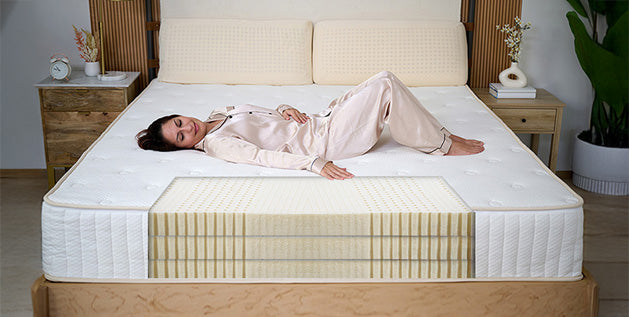
To understand latex mattress firmness, you first need to know what it's made of. Latex mattresses are made from multiple layers of latex foam stacked together inside a cover. And latex foam is made from the sap of rubber trees, which makes it naturally springy, buoyant, and responsive - the complete opposite of memory foam.
Imagine sleeping on spring coils that also cushion you. That'll give you a good idea of what latex feels like in real life.

Most latex mattresses follow a similar structure: a firm or extra-firm base layer for support, one or more medium layers in the middle for transition, and a softer comfort layer on top that your body contacts first. Each layer has its own firmness level, and their combination decides how the finished mattress feels.
You might also like: How Latex Mattresses Are Made
As the very first paragraph of the article so succinctly put, a latex mattress is right in the middle when compared to other mattress types. Not too firm, yet not too soft.
| Mattress Type | Firmness Range* | Feel |
|---|---|---|
| Latex | 4-8 (out of 10) | Responsive, bouncy, supportive |
| Memory Foam | 3-7 (out of 10) | Slow, contouring, cradling |
| Hybrid | 3-8 (out of 10) | Bouncy, balanced, varied |
| Innerspring | 6-9 (out of 10) | Firm, bouncy, minimal cushioning |
*Most common firmness ranges available; not the full range.
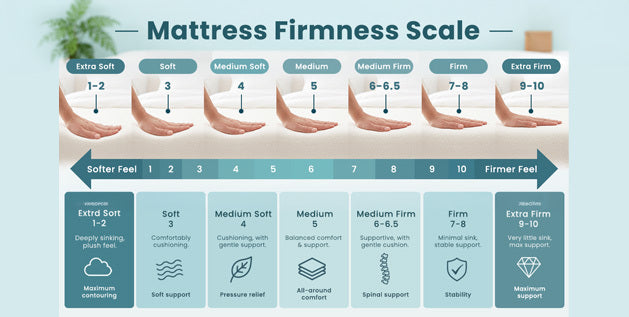
Here's everything you need to know about the 1-to-10 mattress firmness scale.
Most latex mattresses range from Medium-Soft (4) to Firm (8). But that's not to say that there aren't any firmer or softer latex beds. Quite the contrary, as at Turmerry, we offer Extra-Firm latex mattresses too (ranging from 9-10 on the scale). You can also find Soft (3) latex mattresses out there.
Most memory foam mattresses range from Soft (3) to Firm (7). Memory foam responds slowly and conforms closely to the body, letting you sink into it. While that's good for pressure relief, it lacks the pushback heavier sleepers need to keep their spine properly aligned.
Latex gives you similar pressure relief with far more responsiveness. It bounces back the moment you move, making repositioning effortless. Latex also maintains its firmness for 15 to 20 years, while memory foam usually softens in 5 to 8 years.
Suggested read: Latex vs. Memory Foam Mattress
Most hybrid mattresses range from Soft (3) to Firm (8). A hybrid combines a pocketed coil support core with a memory foam or latex comfort layer on top, which gives it a feel closer to latex than any other mattress type. The coils add bounce and edge support, and when the comfort layer is latex, the two materials complement each other well.
The main difference is that an all-latex mattress feels more consistent across the entire surface, since every layer is the same material. A hybrid’s feel can vary depending on the number of coils (coil count), the thickness of the coils (coil gauge), and the comfort layer above it.
Suggested read: Latex vs. Hybrid Mattress
Most innerspring mattresses range from Medium-Firm (6) to Extra-Firm (9). Innersprings use interconnected traditional coils (like Bonnell, offset, or continuous coils) with thin comfort layers on top, which puts them on the firmer end. It's also what makes them the most affordable mattress type.
The trade-off is minimal pressure relief, because the thin comfort layers don’t do much to cushion you, and the interconnected coils transfer motion freely across the surface. Latex offers better cushioning and pressure relief than an innerspring at the same firmness level, along with better motion isolation and a much longer lifespan.
Suggested read: Latex vs. Innerspring Mattress
ILD (Indentation Load Deflection), also known as IFD (Indentation Force Deflection), is the standard measurement for how soft or firm a foam material is. Specifically, it measures the amount of force (in pounds) required to compress a piece of foam (usually 4 inches thick) by 25% of its thickness. The higher the ILD rating, the more force it takes to compress the foam, and the firmer it feels.
ILD is measured using a flat, circular plate called an indenter. The number of pounds-force (lbf) required to reach that 25% compression point is the ILD rating.
In layman's terms: ILD is used to measure the firmness of latex foam. A lower ILD rating means the latex is softer and compresses more easily. A higher ILD rating means the latex is firmer and resists compression.

You can use ILD to compare latex foam options and layer configurations within a brand's collection more reliably than names like "Soft" or "Firm", which vary wildly across the industry.
You can even use ILD to compare memory foam! But memory foam ILD ratings aren’t directly comparable to latex ILD ratings. For example, a 30 ILD memory foam doesn’t feel the same as a 30 ILD latex, because the two materials behave very differently under compression. Use ILD to compare latex to latex, and memory foam to memory foam.
In general, latex ILD ranges from about 14 to 44, with lower ratings indicating a softer feel and higher ratings indicating a firmer feel.
At Turmerry, we use Dunlop latex foam, and our ILDs for each layer (e.g., our Latex Topper) measure as follows [as per the testing standard of (lbf) (ASTM D1055 @25%)]:
Our Soft layer’s ILD sits below the general range for deeper pressure relief. Our Medium layer is balanced for comfort and transition; our Firm layer provides strong pushback and spinal support; and our Extra-Firm layer is built for heavyweight sleepers who need maximum pushback.
Note: Dunlop latex is naturally firmer and denser than Talalay latex. Our ILD ratings may also read lower than other brands’ because test thickness and compression depth vary from one lab and supplier to the next, so we recommend comparing ILDs within the same brand’s lineup. We’ll compare Dunlop and Talalay latex in more detail a few sections down.
The ratings we provided above are Individual Layer ILDs, which are the firmness of a single latex layer on its own. There's another type of ILD too, called Composite ILD, which is the firmness of the entire mattress when all the layers are put together. It reflects what you’ll feel when sleeping on a full mattress, as opposed to a single topper layer.

See how Turmerry's composite ILD for the Organic Latex Mattress compares to the individual layer ILDs listed above:
| Model | Layers* (bottom to top) | Composite ILD |
|---|---|---|
| 7" Medium/Firm | 3" Firm, 3" Medium | ~31 |
| 7" Firm/Extra Firm | 3" Extra Firm, 3" Firm | ~50-52 |
| 10" Soft | 3" Firm, 3" Medium, 3" Soft | ~29 |
| 10" Medium | 3" Firm, 3" Medium, 3" Medium | ~33 |
| 10" Firm | 3" Firm, 3" Medium, 3" Firm | ~37 |
| 10" Extra Firm | 3" Extra Firm, 3" Firm, 3" Extra Firm | ~62 |
| 12" Soft | 3" Firm, 3" Medium, 3" Soft, 2" Soft | ~30 |
| 12" Medium | 3" Firm, 3" Medium, 3" Medium, 2" Medium | ~34-35 |
| 12" Firm | 3" Firm, 3" Medium, 3" Firm, 2" Firm | ~41 |
| 12" Extra Firm | 3" Extra Firm, 3" Firm, 3" Extra Firm, 2" Extra Firm | ~69-70 |
*All models include a 1-inch quilted cover with organic cotton and natural wool.
Composite ILD is a useful tool for understanding the mattress's overall firmness. Individual layer ILD gives you a better idea of how cushioning the comfort layer will feel and how supportive the layers below it will be. Your body contacts the comfort layer first, after all, and it sets the initial feel. The support core beneath decides how well the mattress keeps your spine aligned.
ILD and density measure different things. ILD measures firmness, i.e., how much force it takes to compress the foam. Density measures how much material is packed into a given volume of foam, expressed in kilograms per cubic meter (kg/m³) or pounds per cubic foot (lbs/ft³). They’re related, but they’re not the same thing.
The easiest way to think about it: ILD tells you how the foam feels. Density tells you how long it lasts.

In latex, however, ILD and density do correlate, because denser latex tends to be firmer, and firmer latex tends to be denser. That relationship is reflected directly in our own Dunlop latex layers as well:
A Soft layer at 55 kg/m³ compresses more easily and wears out faster than an Extra-Firm layer at 95 kg/m³, which has nearly double the material density and resists compression longer. This is why firmer latex layers outlast softer ones, and one reason why heavier sleepers are recommended firmer options.
Just an FYI if you're also researching memory foam: Higher density doesn’t always mean firmer when it comes to memory foam. It mainly just affects its structural quality. That’s because memory foam is viscoelastic and heat-sensitive, so higher density changes the foam's sluggishness rather than its surface hardness.
Both Dunlop and Talalay latex come from rubber tree sap. But they’re processed differently, which affects how much softer/firmer they feel compared to one another.

Dunlop latex is made by pouring liquid latex into a mold and baking it in one continuous pour. During this process, natural rubber particles settle toward the bottom, making it firmer, denser, and more supportive overall, which is why Dunlop is the go-to material for support cores. At Turmerry, we use it across most of our mattress lineup.

Talalay latex goes through an additional step. After the mold is partially filled, it’s vacuum-sealed to expand the latex evenly throughout, then flash-frozen before baking. This extra process gives Talalay a more uniform cell structure from top to bottom, which makes it softer, lighter, and more consistent in feel. Because of this, Talalay is often used as a comfort layer, but rarely ever used as the support core.
| Dunlop Latex | Talalay Latex | |
|---|---|---|
| Feel | Firmer, denser | Softer, more uniform |
| Weight | Heavier | Lighter |
| Durability | Higher | Slightly lower |
| Common Use | Support core, comfort layer | Comfort layer |
| Best For | All sleeper types, heavier sleepers | Lightweight sleepers, pressure relief |
So, at the same ILD, Dunlop latex and Talalay latex can feel different. Dunlop feels more grounded/supportive, even at softer ILD levels, while Talalay feels more airy/cushioned. If you’re stuck choosing between the two, Dunlop latex mattresses are the more versatile option. They're more affordable, too. Consider Talalay latex mattresses if maximum softness is your priority.
Now that you're all caught up on latex mattress firmness and ILD, let's get down to the most important question: how do you apply all of this in practice and get yourself the ideal latex mattress?

Just as we provided ILDs and density ratings for our latex mattress, look for ILDs wherever you shop. If you don't find them right away, contact the retailer to see if they can provide them. Once you have those ILD numbers, choosing the best latex mattress for you becomes much easier.
Make sure to ask whether they're providing individual layer ILDs or composite ILDs, so there isn't any confusion. Most brands provide individual layer ILDs.
ILDs are best used when comparing options within one brand’s lineup. They’re also a handy rough guide when comparing latex between brands. Testing methods vary from brand to brand, though, so use ILD to narrow your options instead of picking a winner right away.

Your body weight is one of the biggest factors in how deeply you press into the layers.
Adjust this recommendation based on your sleeping position. Go slightly softer if you sleep on your side, and go slightly firmer if you sleep on your stomach.

Your sleeping position decides where your body needs cushioning and where it needs support.
Not sure where your sleep position lands? Our mattress firmness scale breaks it down in more detail.

Your mattress thickness decides how much cushioning there is between you and the support core. For most sleepers, 10 to 12 inches is perfect. Lightweight sleepers and single sleepers can do well with 10 inches or less. Heavyweight sleepers and couples should go for 12 inches or more.
Thickness also affects the composite ILD of a mattress. The same firmness level reads a little higher in a thicker mattress. For example, our 10-inch Firm is around 37, while our 12-inch Firm is around 41.

Choose a mattress size that fits your room and comfortably accommodates everyone in the bed. Twin, twin XL, and full-size mattresses are ideal for kids and single sleepers. Queen (most popular), king, and California king-size mattresses are ideal for couples and co-sleeping families.
If you and your partner want different firmness levels, go for a split size. A split queen, split king, or split California king is two mattresses side by side. Each person gets the firmness they want on their side. Plus, motion isolation improves a whole lot more.

Even with the right ILD on paper, you can’t know how a mattress feels until you sleep on it. That’s why we recommend picking one you can adjust at home.
Look for a mattress with a zippered cover. It lets you open the mattress and rearrange the layers. Since every layer has its own ILD, changing their order changes the feel. Our latex mattresses work this way, and we offer one free layer swap during the 120-day trial if you want to try a different firmness.
A flippable design is another option, like our dual-side mattress, with Medium on one side and Firm on the other, or Firm on one side and Extra-Firm on the other. If your needs change, you just flip it over.

A warranty shows how much a brand trusts its own mattress. Look for at least 10 years, as high-quality latex lasts a long time (15-20 years or more), and make sure it covers sagging and body impressions. Ours is up to 20 years.
The trial period is just as important. Your body needs 2 to 4 weeks to adjust to a new mattress, so look for at least 60 to 90 days. Ours is 120 days, with free US shipping.

The term "natural latex" isn’t regulated in the US, so a mattress can be mostly synthetic latex and still carry the label. Certifications show you whether the latex you’re getting is truly organic.
GOLS (Global Organic Latex Standard) is the best certification for the latex itself. To carry it, the latex must contain at least 95% certified organic raw material. GOTS (Global Organic Textile Standard) covers the fabric, like organic cotton and wool.
OEKO-TEX, Greenguard Gold, and eco-INSTITUT test for harmful substances and VOC emissions, while FSC covers responsibly sourced wood.

A few other features worth having in your latex mattress are zoning, edge support, and motion isolation.
Most latex beds offer edge support and motion isolation, but zoning is a unique something that you won't find everywhere.

A latex mattress costs more upfront, owing to the difficulty of sourcing the material. But it also lasts the longest. At 15 to 20+ years, the cost per year comes out lower than a cheaper bed you replace in 5 to 8 years. That's why it's considered the best mattress for the money today.
For a queen latex mattress, you can expect to pay about $1,500 to $3,000, sometimes more.
Watch out for very low prices. Some mattresses sold as latex only have a thin latex layer over polyfoam. Check the layers and their thicknesses, and ask whether the whole mattress is latex.
If the upfront cost stretches your current budget, opt for monthly financing instead.

The same firmness can feel very different from one sleeper to the next. So when you read reviews of a latex mattress (or any mattress, for that matter), filter for people with a similar body weight and sleeping position.
If they share any health conditions with you, too, then huzzah! That’s your sleeper twin, and they’ve already done the testing for you.
Pay close attention to reviews from long-time users, especially if they mention a change in firmness over time. They’re the best clue to how a mattress performs.
We use GOLS-certified organic latex (the highest standard) across our latex mattresses. You can customize them to how you sleep best, with Soft, Medium, Firm, and Extra-Firm options (ranging from 4-10 on the firmness scale) across three thicknesses: 7, 10, and 12 inches.
It doesn't end there, because you can adjust the firmness of a Turmerry mattress in your own home! Every mattress ships free across the US and includes a 120-day trial period, so you can try it confidently before you buy.
Find out which Turmerry latex mattress suits you best:
Take the 1-minute mattress quiz

Most mattresses lock you into one firmness from the day you buy them. Turmerry mattresses come with three features that give you absolute control over how your mattress feels:
Your Turmerry mattress adapts to your body instead of the other way around. We also offer a DIY Hybrid Mattress that combines TPS QuadCoil pocketed coils (15.5 gauge) with our signature 7-zone Dunlop latex comfort layer, fully customizable to your desired firmness level.

A latex mattress is buoyant, responsive, and cushioning. That's how it naturally feels. You'll find it to be more supportive than memory foam, and more comfortable than innersprings. ILD and density affect how the latex layers feel under you. Lower ILD and density mean softer latex, while higher ILD and density mean firmer latex.
From there, it comes down to you. Your body weight and sleeping position tell you how soft/firm to go. Mattress thickness, size, and customizability help you fine-tune it. And certifications, along with a solid warranty and honest reviews, tell you whether the mattress is worth the budget you've set aside.
Still unsure? That’s what the trial period is for! Our Organic Latex Mattress comes with a 120-day trial, so you can sleep on it and see for yourself. Or, if you just need to adjust the firmness of your current latex mattress, get an affordable latex mattress topper instead.
Related blog posts:


Disclaimer: What is said in this article has been referenced from multiple sources and is intended only for educational and informational purposes. Please note that no content in this article is a substitute for professional advice from a qualified doctor or healthcare provider. Always consult an experienced doctor with any concerns you may have regarding a health condition or treatment, and never disregard any medical suggestions or delay in seeking treatment because of something you read here.