No Products in the Cart



Last Updated September 28, 2026
Are you thinking of buying a gel mattress topper? If so, you need to know a few things. For example, is a gel topper any better than a latex topper? Especially when it comes to cooling? Or will you just be paying for an expensive synthetic foam without getting the benefits that latex provides at the same price?
In this article, we'll discuss the key characteristics and the pros and cons of gel mattress toppers, compare them with those of latex mattress toppers, and figure out which is the best mattress topper option for you. Keep reading to find out!
Key Takeaways:

A gel mattress topper is an extra layer of bedding made from memory foam infused with cooling gel beads. You add it on top of your current mattress to improve its feel. The cooling gel beads help dissipate body heat and prevent the heat retention that plagues traditional memory foam. The gel infusion also gives it its signature blue color.
Like memory foam, gel toppers contour closely to the body and relieve pressure points effectively. The difference is that the gel component attempts to counteract memory foam's biggest weakness: sleeping hot. How well it does that depends largely on the topper's quality. Cheaper gel toppers lose their cooling effectiveness fairly quickly.

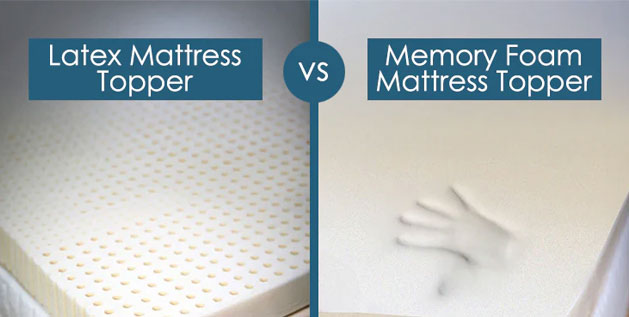
A latex mattress topper is an extra layer of bedding made from the natural sap of rubber trees (latex), processed into foam through either the Dunlop or Talalay method. Dunlop latex is denser and more supportive, while Talalay latex is softer and more cushioning. Both are solid options. They feel very different from gel toppers.
Unlike gel memory foam, latex doesn't rely on synthetic cooling technology to sleep cool. Its open-cell structure and pin-core perforations allow for natural airflow, keeping you comfortable through the night without any added chemicals. It also strikes a better balance between contouring and support, giving you pressure relief without the stuck feeling gel memory foam can create.

This table covers everything you need to compare between gel toppers and latex toppers:
| Category | Gel Mattress Topper | Latex Mattress Topper |
|---|---|---|
| Material | Gel-infused memory foam | Natural rubber sap (latex) |
| Support | Good for lightweight sleepers | Better for all body weights |
| Comfort | Deep contour with hugging feel | Balanced cushioning and support |
| Cooling | Cooler than regular foam | Naturally breathable & cooling |
| Durability | 3 to 5 years | 5 to 10+ years |
| Eco-Friendliness | Synthetic & petroleum-based | Natural & sustainable |
| Chemicals | Polyurethane (VOCs) | No harmful chemicals |
| Hypoallergenic | Yes | Yes |
| Maintenance | Spot clean only | Spot clean only |
| Upfront Cost | More affordable | Higher upfront cost |
| Long-Term Value | Frequent replacements | Lasts much longer |
| Best For | Side sleepers, joint pain, those on a budget | Most sleeper types, hot sleepers, eco-conscious buyers |
Latex has the edge here. It offers a more responsive, adaptive surface that supports sleepers across all body weights, including heavier sleepers who sink too deeply into gel memory foam. Gel toppers do provide reasonable support for lightweight and average-weight sleepers, but they lack the resilience to hold up well under more pressure over time.
Both toppers are comfortable, but in different ways. Gel memory foam contours very closely to the body, which feels great for those who love that cradled feel. Latex, on the other hand, offers more balance, with enough cushioning for pressure relief without sinking you into it. If you move around a lot during sleep, latex is the more comfortable choice.
Gel toppers are designed to keep you cooler than traditional memory foam, and they do, but only to a point. The gel infusion helps dissipate heat initially, but it doesn't eliminate the heat retention problem that comes with polyurethane foam. Latex, by contrast, stays cool naturally. Its open-cell structure and perforations allow for consistent airflow throughout the night, no cooling technology required.
Latex lasts a lot longer than gel foam. A high-quality latex topper can last anywhere from 5 to 10 years or more, maintaining its supportive qualities throughout. Gel toppers only last around 3 to 5 years before sagging sets in and the cooling effectiveness starts to fade. If longevity is important to you, latex is the clear choice.
Natural latex comes from rubber trees, making it sustainable and free from the harmful chemicals used in synthetic foam production. Gel toppers are made from polyurethane, a petroleum-based material, and off-gas VOCs when new. For health-conscious and eco-conscious buyers, latex is the obvious pick.
Both toppers require similar care: spot-cleaning with mild soap and water (in case of spills/stains), no harsh chemicals, and proper storage in a cool, dry place. Neither should be machine washed or folded. The main difference is that latex is more resilient to wear, so it holds up better between cleanings and over its lifespan.
Gel toppers cost less upfront, around $50 for the cheapest to $400 or more for quality ones. They're an attractive
option for budget-friendly shoppers. But their shorter lifespan means you'll be replacing them sooner, which can
bring the total cost close to, or even above, what you'd have spent on a latex topper ($100 to $500+) from the
start. Think of latex as the higher upfront investment with the better long-term return.
For most sleepers, latex is the better topper. It outperforms gel memory foam in support, cooling, durability, and eco-friendliness, and offers better long-term value despite the higher upfront cost. Gel toppers are a decent option if you're on a tighter budget or if you love the deep contouring feel of memory foam and want a cooler version. But if you want a topper that performs well across the board and lasts, choose latex.
Before you buy a new mattress topper, keep a few things in mind:

Firmness is one of the most important factors to get right. Side sleepers and lightweight sleepers (under 130 lbs.) need extra cushioning and sleep better on a soft topper. Back sleepers and average-weight sleepers (130-230 lbs.) need balance and sleep better on a medium topper. Stomach sleepers and heavyweight sleepers (over 230 lbs.) need extra support and sleep better on a firm or extra-firm topper.

Thickness affects both comfort and support. A thicker topper provides more cushioning and pressure relief, while a thinner topper offers a subtler change. For most sleepers, 3 inches is the sweet spot. Go thicker (4 inches) if you need more cushioning on a very firm mattress, or go thinner (2 inches) if you just want a slight upgrade to an already comfortable bed.

Always match your topper to your mattress size. A topper that's too big will bunch and slip; a topper that's too small won't cover the bed properly. Most toppers come in standard sizes: twin, twin XL, full, queen, king, and California king. Measure your mattress before buying.

A good warranty tells you a lot about a brand's confidence in its product. Look for at least a 3- to 5-year warranty. A trial period is equally important, as it gives you time to sleep on the topper and decide whether it works for you before committing fully. A 60-90 day trial should be a minimum.

Gel toppers cost less, so they're a solid short-term option. Latex costs more at first, but it makes up for it by lasting longer and performing better over time, making it the better long-term option. Before you buy, think beyond the sticker price and consider how long you need the topper to last. A cheaper topper replaced every 3 years can easily outspend a latex topper that lasts a decade.
At Turmerry, we believe you deserve better than a synthetic foam that wears out in a few years. That's why we offer a range of premium, GOLS-certified cooling latex mattress toppers, each designed to keep you comfortable all night. Every order comes with free shipping, a 120-night trial, and a 5-year warranty.

Our classic Latex Mattress Topper and RV Mattress Topper are made from organic latex with pin-core perforations for natural airflow and cooling. They're supportive, responsive, and built to last - the gold standard for sleepers who want the real thing.
If you want an extra cooling boost, our Cooling Mattress Topper combines the benefits of natural latex with graphite infusion, drawing heat away from the body for an even cooler sleep surface.
And for those who want maximum airflow with extra pressure relief, our Egg Crate Mattress Topper features a unique convoluted design that promotes exceptional ventilation while cradling the body.

Disclaimer: What is said in this article has been referenced from multiple sources and is intended only for educational and informational purposes. Please note that no content in this article is a substitute for professional advice from a qualified doctor or healthcare provider. Always consult an experienced doctor with any concerns you may have regarding a health condition or treatment, and never disregard any medical suggestions or delay in seeking treatment because of something you read here.